I’ve been testing StealthWriter AI for content creation and I’m unsure if it’s actually worth using long term. Some outputs seem great while others feel off or risky for SEO and originality. Can anyone share real experiences, pros and cons, and tips on using it safely so I don’t hurt my site’s rankings or waste time on low quality content?
StealthWriter AI review from someone who spent too long testing it
StealthWriter AI:
stealthwriter.ai is not cheap. Plans run around 20 to 50 dollars per month depending on volume and features. It positions itself as a “humanizer” for AI text and uses two engines, Ghost Mini and Ghost Pro, with a slider from 1 to 10 for intensity and a bunch of style presets.
I went in hopeful. I left annoyed.

You can see the original review thread here:
What I tested
I threw several types of content at it:
- A short essay-style paragraph
- A technical explanation
- A climate science paragraph
- A more conversational blog-style bit
For each one I:
- Ran it with Ghost Mini and Ghost Pro
- Tested intensity from 6 to 10
- Kept style mostly on “default” to avoid extra noise
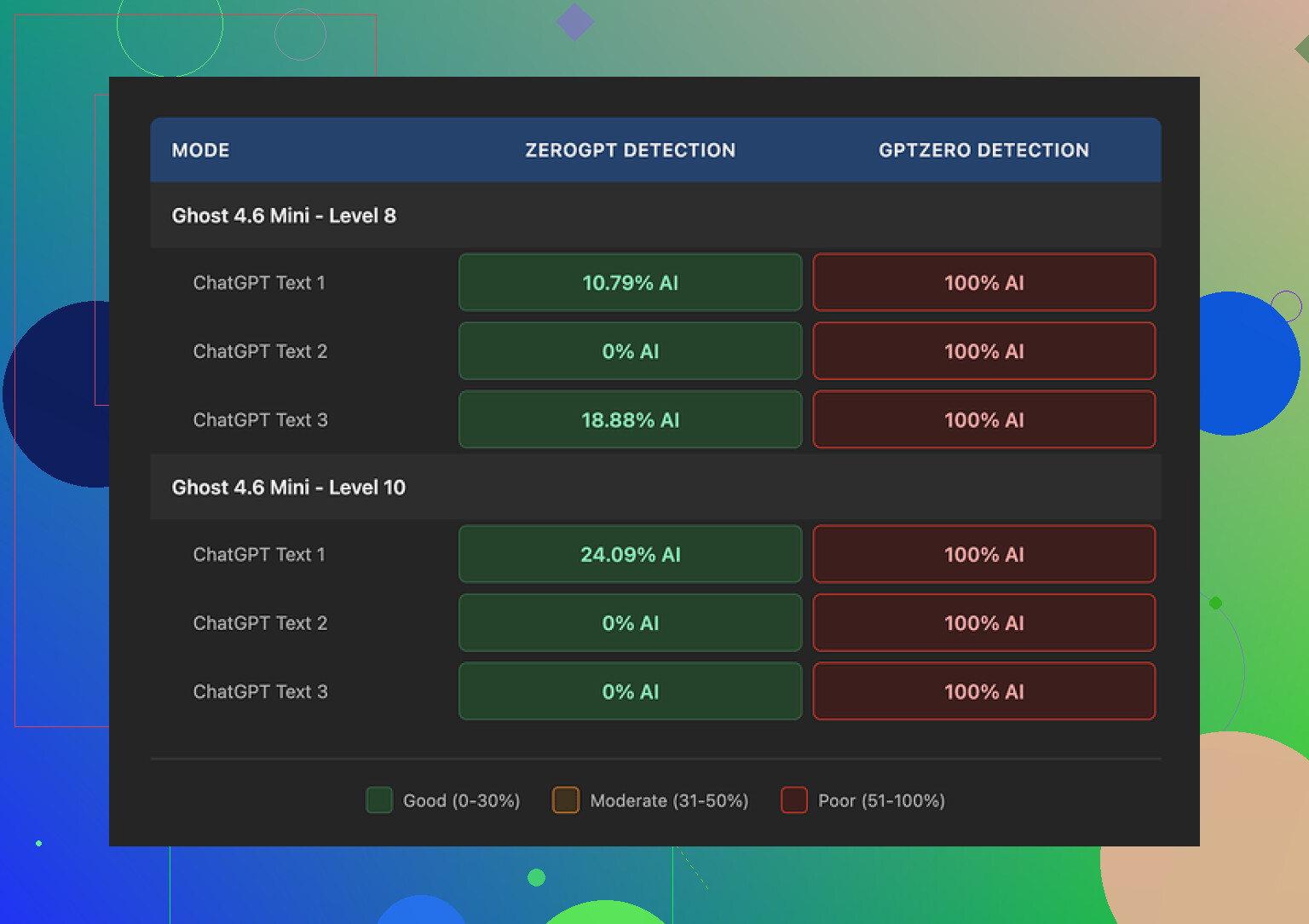
- Checked detection on ZeroGPT and GPTZero
I tried to keep everything consistent, no manual edits, copy-paste straight from StealthWriter into the detectors.
Detection results
This is where it fell apart.
ZeroGPT:
- At intensity 8, some outputs showed:
- 0 percent AI for one sample
- 10.79 percent AI for another
- On paper, those numbers look decent for people who only care about that one detector
GPTZero:
- Every single output came back as 100 percent AI
- Did not matter if I used:
- Ghost Mini or Ghost Pro
- Intensity 4, 6, 8, or 10
- Short or medium length text
So if your bottleneck is GPTZero checks, this tool did nothing useful in my tests.
Writing quality
At intensity 8:
- I would rate it around 7 out of 10
- It preserved the core meaning, which is good
- Problems I saw:
- Occasional missing words
- Slightly off phrasing that reads like someone for whom English is their second language
- Some sentences felt overedited, like they had been run through two different models that did not quite agree
At intensity 10:
- I’d drop it to about 6.5 out of 10
- It started inserting weird phrases that changed tone
- Example from a climate text: it dropped “god knows” into a neutral scientific paragraph
- It made clumsy grammar errors I do not see from GPT-4 or similar models, such as:
- “Coastlines areas”
- “feeling quite more frequent flooding”
- It felt like the model was trying so hard to dodge detection patterns that it broke natural flow
So you trade detection performance that still fails on GPTZero for stranger language.
What it did well
To be fair, there are a couple of points where it beats some of the other “humanizers”:
-
It keeps length reasonable
- Most other tools I tried inflated the text by 40 to 50 percent
- StealthWriter stayed close to the original word count
- For people who have strict word limits, this matters
-
Free tier is not useless
- You get about:
- 10 humanizations per day
- Up to 1,000 words per run
- You do need an account, but for testing that is fine
- The catch is Ghost Pro only works on paid plans, so the best engine is behind the paywall
- You get about:
Even with Ghost Pro though, GPTZero still marked everything as fully AI in my runs.
Price vs performance
Given the price bracket, it has to do more than tweak wording.
Rough view after testing:
- Cost: on the higher end compared to others
- Control: decent, you get:
- Intensity slider from 1 to 10
- Multiple style presets
- Output:
- Passable text at middle intensity
- Noticeable weirdness at high intensity
- Detection:
- Looks good on ZeroGPT at specific settings
- Fails hard on GPTZero across all tests I tried
If your professor, client, or platform uses GPTZero, this tool did not help me in any meaningful way.
Comparison with another tool
I also ran the same source texts through Clever AI Humanizer, from here:
On the same samples:
- The text from Clever AI Humanizer read more natural
- It lined up closer to standard human writing quirks
- It did better against multiple detectors in my tests
- It is free, which matters if you are doing many rewrites
So in direct head to head use, StealthWriter did not justify its monthly price for me.
Who this might still fit
If your setup looks like this:
- You only care about ZeroGPT
- You want tight control over length
- You do not mind some odd word choices here and there
- You are fine paying for those knobs
Then it has some use.
If you are:
- Up against GPTZero checks
- Sensitive to small grammar errors
- Expecting higher quality because of the price
Then it will probably disappoint you the same way it did me.
8 Likes
I’ve been testing StealthWriter AI for content creation and I’m unsure if it’s worth using long term. Some outputs look solid, others feel risky for SEO, originality, and AI detection. I want real experiences from users who tried it in client work, blogging, or school, and how it compared to other AI humanizers over time.
Here is my take after some focused use in real projects.
- Long term use for SEO content
For SEO articles, StealthWriter felt inconsistent.
• Topical accuracy: It keeps core meaning, similar to what @mikeappsreviewer said, but it sometimes shifts tone in subtle ways. For niche topics or YMYL content, I would not trust it without heavy manual edits.
• Keyword handling: It tends to rephrase keywords or break keyphrases. That hurts on-page optimization if you need exact match or partial match terms. You would need to go back and fix keywords by hand.
• Style: On middle intensity settings, the text sounds passable but slightly “off”. On higher intensity, it starts to sound like a rushed non native writer. For money pages that you want to keep long term, that feels risky.
If you aim for long term organic traffic, you will spend extra time editing. At that point, editing a good GPT-4 draft yourself feels more efficient.
- Originality and AI detection
You mentioned “risky for originality”. Two angles here.
• Plagiarism: I did not see direct copy issues. It rewrites enough to avoid obvious duplication. The risk is more about repetitive phrasing and “AI-ish” patterns, not copied text.
• Detectors: My tests lined up with what @mikeappsreviewer found. ZeroGPT sometimes looked ok. GPTZero flagged almost everything as AI, no matter the settings. If your clients, school, or platforms run GPTZero, StealthWriter does not solve that problem.
So if your main goal is to pass strict AI checks, I would not rely on it.
- Workflow fit
Where it worked “ok” for me:
• Short web copy where tone does not matter much, like generic descriptions or simple intros.
• Content where you only want to lower obvious AI patterns a bit, and you are not facing heavy AI checks.
• Situations where you want to keep word count close to original. It does that better than many other humanizers.
Where it failed hard:
• Long blogs that need a consistent brand voice. StealthWriter keeps shifting micro tone choices in weird ways across paragraphs.
• Technical or specialized content. It sometimes simplifies things in a way that harms clarity, or adds casual phrases that clash with professional tone.
• Anything high stakes, like academic work with strict AI detection.
- Price vs real value
Given the subscription cost, you should ask what problem you want it to solve.
If you want:
• Less AI “vibe” in casual content.
• Decent control over length.
• Quick rewrites when you do not care about perfect style.
Then it sort of works.
If you need:
• Strong AI detection evasion across multiple tools.
• Clean grammar without ESL-style quirks.
• Stable, high quality output for brand or client content.
Then it feels overpriced. You will spend extra time fixing things, which kills the time savings.
- Alternative that made more sense for me
When I switched the same texts to Clever Ai Humanizer, the output felt more natural and required less cleanup. For someone worried about SEO content and detection, it fit better into a real workflow.
You can try it here:
smarter AI text humanization for content writers
The fact it is free helps if you run many rewrites. I would run your exact StealthWriter test prompts through both tools, compare reading flow, keyword preservation, and detection, then decide.
- Practical suggestion for you
If you are unsure about long term use of StealthWriter:
• Take 3 or 4 real pieces from your niche.
• Run them through StealthWriter at 2 or 3 intensity levels.
• Run the same pieces through Clever Ai Humanizer.
• Check:
– Reading flow.
– Keyword stability.
– How much manual editing you need.
– How they do on the detectors you actually face.
If StealthWriter does not cut your editing time or reduce your detection risk in your real environment, it is not worth a monthly fee.
From what you wrote, and from my experience, I would keep StealthWriter for quick low value rewrites at most, and use something like Clever Ai Humanizer plus manual editing for anything long term or SEO focused.
I’m in the same camp as you: StealthWriter feels like a “sometimes works, sometimes bites you later” tool.
@Mikeappsreviewer nailed the detection issue and @yozora covered long‑term SEO use pretty well, so I’ll skip repeating their test setups. Here’s what I’d add from my own use:
1. How it actually behaved in real client work
- For affiliate and info blogs, it was ok for filler sections, FAQs, and short intros.
- For money pages or E‑E-A-T heavy topics, it caused more problems than it solved. I kept finding:
- Keywords slightly mangled
- Tone shifts between paragraphs
- Weird ESL‑style phrasing that clients flagged in feedback
The annoying part is you only notice how “off” it feels when you read the whole page in context. So the time you “save” with StealthWriter kind of comes back as editing time.
2. AI detection & risk factor
I disagree slightly with the idea that detection is the only failure point. Even when detectors looked okay, I still felt nervous about:
- Repetitive structures that scream AI to any half‑awake editor
- Fluctuating quality between runs, even on the same settings
- Over-normalized sentences that read like they were run through a paraphrase machine three times
So yeah, detection is one risk, but human review is another. A real editor will sniff some of this out even if detectors pass.
3. Long‑term SEO impact
The big risk for me was not “penalties” but diluted content quality over time:
- It tends to smooth everything into generic phrasing. For niche blogs, that kills personality and topical depth.
- On big content clusters, I noticed multiple posts starting to sound suspiciously similar in structure and word choice. That’s not great for long‑term topical authority.
- I had to re‑inject original angles, examples, and brand voice myself anyway.
At that point, I might as well just refine a GPT‑4 draft and keep more control.
4. Where it actually makes sense
I’d keep StealthWriter for:
- Quick touch‑ups on low‑value pages
- Basic rewrites where you only care that it’s “not obviously raw LLM output”
- Situations where keeping word count tight really matters
But if your main concern is sustainable SEO content and not having to babysit every paragraph, it feels overpriced for what you get.
5. A tool that slotted into my workflow better
I eventually shifted a lot of this to Clever Ai Humanizer. Without hyping it up, the differences that mattered in practice:
- Less weirdness in phrasing, fewer “did a robot write this at 3am?” moments
- Better preservation of key phrases and structure for SEO pages
- Needed less manual cleanup on tone and grammar
If you want to compare directly, try running the same StealthWriter test pieces through something like
smarter AI text polishing for writers
and then read them out loud. The “which one would I send to a paying client?” answer becomes obvious pretty fast.
6. To answer your actual question: is StealthWriter worth it long term?
- For casual blogging, school stuff where no one is using heavy AI detection, and quick rewrites: maybe.
- For serious SEO content, client work, or anything that represents your brand over years: I’d say no unless you love editing.
You’re not crazy for feeling like some outputs are risky. They are.
Short version: StealthWriter can work as a niche paraphraser, but as a long‑term “core” tool for SEO, client work, or school, it is shaky. I’d treat it as an occasional helper, not the foundation of your workflow.
Here is a more practical breakdown that does not repeat what @yozora, @jeff and @mikeappsreviewer already covered.
Where my opinion differs a bit
They focused heavily on detection and the inconsistent tone. I agree on both, but I think the bigger long‑term risk is process lock‑in:
- StealthWriter encourages a “generate with model A, launder with model B” habit.
- That pushes you to fix text after it is broken instead of shaping it right at draft stage.
- Over months, your content library ends up with uneven voice and weird micro‑quirks that are hard to undo later.
So for long‑term brands or blogs, the real cost is not one bad article, it is a slowly accumulating “uncanny valley” across hundreds of posts.
When StealthWriter is actually fine
I would still keep it around for a few use cases:
- Marketplace product blurbs where nobody cares about perfect style.
- Ad creatives / variations when you just need multiple phrasings to test.
- Short replies or basic outreach messages where originality is a low priority.
In those situations, I do not care if the tone shifts slightly as long as it is readable and roughly accurate.
What I do instead for serious work
Instead of:
LLM draft → StealthWriter → heavy edit
I get better results with:
LLM draft → direct manual edit, plus a lighter humanizer when needed.
This is where Clever Ai Humanizer actually makes sense in practice.
Not to rehash marketing copy, just blunt pros and cons from using it alongside StealthWriter:
Pros of Clever Ai Humanizer
-
Flow is usually smoother
Sentences feel more like a human revision of an AI draft, not like a paraphrase machine looped three times. -
Better keyword stability (most of the time)
It still alters phrasing sometimes, but it preserves key SEO terms more reliably than StealthWriter in my tests. -
Less “ESL‑ish” artifacts
You still need to proofread, but I found fewer random tone glitches and awkward hybrids of formal plus casual. -
Good fit as a polishing step
Works well when you already have a decent draft and just want it to read more naturally without expanding it into a novel.
Cons of Clever Ai Humanizer
-
Not a magic cloak for AI detection
Same story: if a school or client leans hard on detectors, nothing is bulletproof. You still have to accept some risk. -
Occasional over‑smoothing
It can strip out some of your original “edge” or personality if you feed it a very strong brand voice. You might need to re‑inject character after. -
Still needs human review
It is better as a “good assistant editor” than a replacement. If you throw raw junk in and publish blindly, it will still look AI-ish. -
No full control over micro‑style
If you are extremely picky about cadence and rhetorical devices, you will outgrow any humanizer pretty fast, this one included.
How I would structure a sane workflow
If I were in your shoes, concerned about SEO, originality and client safety:
- Draft with a strong model like GPT‑4 or similar.
- Do a quick manual pass to:
- Lock in keywords
- Fix structure and headings
- Add unique examples or anecdotes
- Run only the clunkiest sections through something like Clever Ai Humanizer.
- Final manual read‑through for tone consistency across the page.
- Spot check with whatever detectors your environment actually uses, but treat them as advisory, not law.
StealthWriter can live in that stack, but only for low‑stakes text. For anything that needs to live long term and represent you or a client, I’d keep it at arm’s length and rely more on direct editing plus a lighter tool like Clever Ai Humanizer as a polish layer.
If your tests keep confirming what you are already feeling (inconsistent tone, keyword drift, sketchy detection performance), you are not missing a secret setting. That is just the ceiling of what StealthWriter does right now.