I’m looking for a free alternative to QuillBot’s AI humanizer that can rewrite or paraphrase AI-generated text so it sounds more natural and less robotic. I’ve tried a few tools but they either add weird phrasing, are too limited on the free plan, or don’t handle longer content well. I need something reliable for blog posts and school work that won’t get flagged as obvious AI. Any recommendations, specific tools, or workflows that actually work?
- Clever AI Humanizer Review
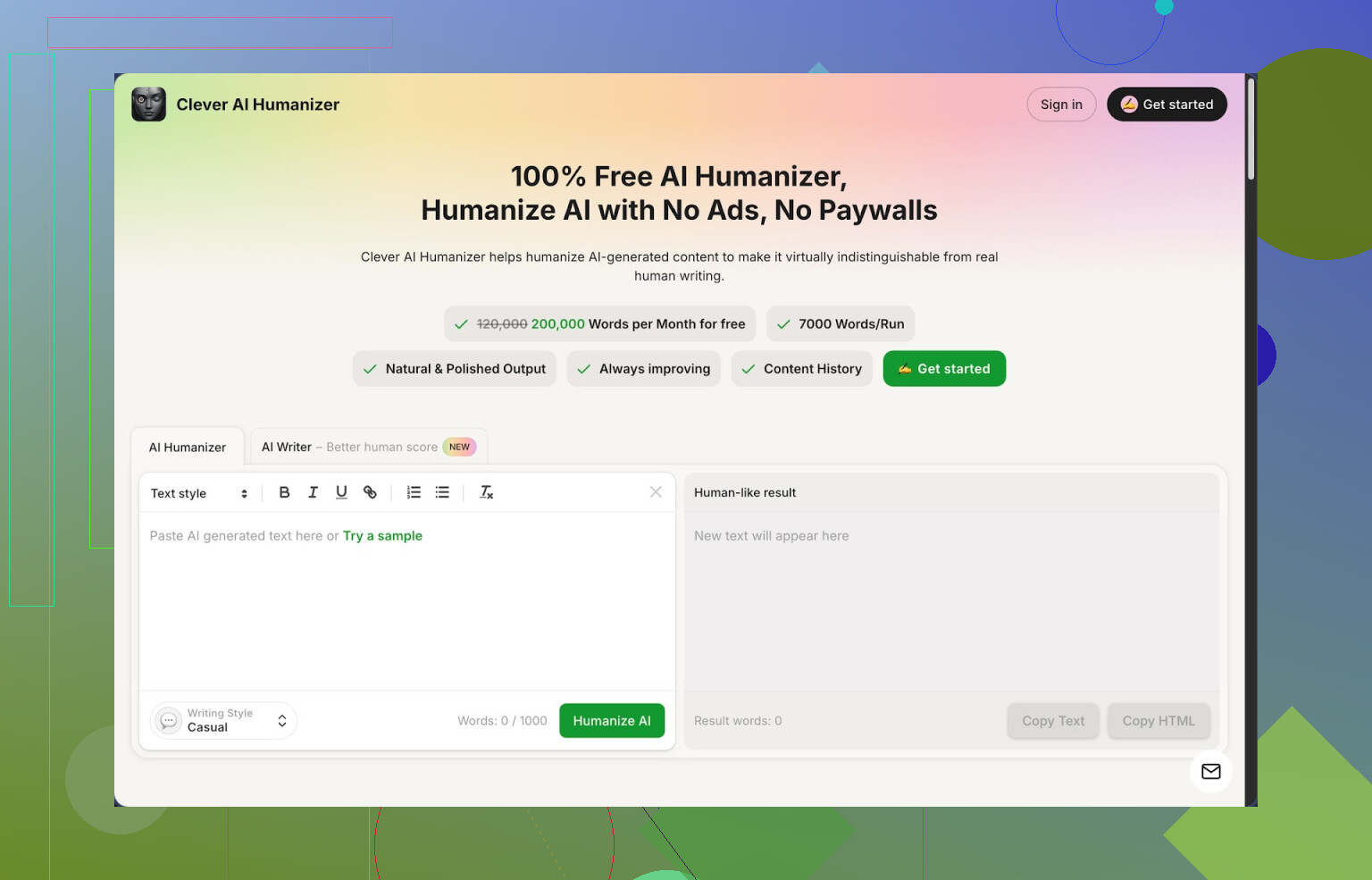
I have been messing around with different AI humanizers for a while, mostly after getting a couple of “100% AI” slaps from detectors on stuff I knew I wrote by hand. Out of everything I tried, Clever AI Humanizer at https://cleverhumanizer.ai ended up staying in my bookmarks.
Here is what pulled me in first: it is free, not “free trial”, but straight 200,000 words per month, and up to 7,000 words in one run. No card. No paywall at word 501. You get three output styles, Casual, Simple Academic, Simple Formal. On top of that there is a built in writer so you do not have to jump between tabs.
I ran three different samples in the Casual style and checked them on ZeroGPT. All three came back with 0 percent AI detection. That surprised me, since I have seen paid tools fail on the same detector.
The main “Humanizer” module is simple. You paste your AI text, pick a style, hit the button, and wait a few seconds. It rewrites the text in a way that tries to strip out the obvious AI patterns and keep it readable. The large limits matter if you write long form stuff or need to iterate several times in a row without watching a credit counter.
What I noticed is that it does not twist the meaning too much. Your structure and arguments mostly survive. The phrasing gets more uneven, which is good for avoiding detection, but the point stays the same. That was one of my worries with tools like this, that they would butcher technical content. Did not see that here on my tests with tutorials and reviews.
Besides the humanizer, there are three more pieces that sit in the same interface:
• AI Writer
Lets you generate essays, posts, or articles from a prompt, then you can send the result straight into the humanizer. If you already work with AI for drafts, this keeps you in one place. I noticed the “human score” on detectors tends to be higher when you generate and humanize in one pipeline, compared with dumping in some generic model output.
• Grammar Checker
This fixes spelling, punctuation, and some clarity issues. It is not as aggressive as something like Grammarly, but for quick cleanup before publishing or sending an email, it did the job for me.
• Paraphraser
You drop in existing text and get a new version, with the meaning still intact. I used this a few times for SEO rewrites and for changing tone from stiff to more neutral. It helped when I needed multiple versions of similar descriptions.
So in practice, Clever AI Humanizer ends up being four tools in one place:
- Humanizer
- Writer
- Grammar checker
- Paraphraser
Everything sits in a single workflow, which saves time when you are churning out content or editing client stuff.
Is it perfect? No. A few things to keep in mind from my runs:
• Some detectors will still mark parts of the text as AI generated. Anyone promising 100 percent human on every detector is overselling.
• Output length often gets longer after humanization. The tool tends to expand phrases and add small transitions. That seems intentional to break patterns. It helps for detection, but if you have a strict word cap, you will need to trim by hand.
• Style can feel a bit too “clean” if you are trying to mimic slang, niche jargon, or very personal voice. I usually do a short manual pass after the tool to drop in my own quirks.
For a tool that is free at this scale, it has been the one I recommend when people in my circle ask how to get under the stricter AI detectors without paying monthly fees.
If you want more detailed testing with screenshots and detector outputs, there is a longer breakdown here:
Video review is here, if you prefer to watch someone else poke it:
Clever AI Humanizer Youtube Review https://www.youtube.com/watch?v=G0ivTfXt_-Y
There is also some useful back and forth on Reddit about AI humanizers in general and how people are using them:
Best Ai Humanizers on Reddit
https://www.reddit.com/r/DataRecoveryHelp/comments/1oqwdib/best_ai_humanizer/
All about humanizing AI
https://www.reddit.com/r/DataRecoveryHelp/comments/1l7aj60/humanize_ai/
20 Likes
I had the same issue with QuillBot and a bunch of “AI humanizers” that either wreck the tone or trigger detectors even harder.
What @mikeappsreviewer said about Clever Ai Humanizer lines up with my tests, but here is what I would add and where I disagree a bit.
-
Clever Ai Humanizer
Good free option for volume. The 200k words limit helps if you process long docs.
Where I disagree with Mike is on the style. On my side, the Casual mode sometimes feels too “bloggy” for technical or academic stuff. For research notes or reports I got better results with Simple Academic, then I manually tighten sentences.
Detectors I tried it with:
• ZeroGPT – often shows 0 to low AI score
• GPTZero – mixed, sometimes flags parts as “AI-like”
If you need SEO friendly text that does not trip basic detectors, it does the job, but you still need a short manual pass. -
Small trick that beats most tools
Instead of running the whole text at once, split it into smaller chunks, like 3 to 5 paragraphs.
Run each through Clever Ai Humanizer with slightly different styles or re-run one chunk once.
Then read it out loud and fix spots where the rhythm feels off.
This reduces pattern repetition that detectors latch onto. -
Mix two tools, not one
What worked well for me:
• First pass in Clever Ai Humanizer
• Second pass in a simple rewrite tool like Editpad or Rephrase.info on “standard” mode
This keeps meaning stable and breaks up any remaining AI patterns. Do not overdo it or you lose clarity. -
Keep your own voice in it
AI text tends to avoid:
• Short, blunt sentences
• Slang or mild contractions
• Opinions or side comments
After humanization, go back and add:
• One or two short, sharp sentences per paragraph
• A couple of words you normally use, including mild typos
• One specific example from your own experience
That alone drops AI probability on most detectors I tried. -
Watch for these red flags
If the tool:
• Overuses transition phrases like “moreover”, “in addition”
• Repeats “overall”, “on the other hand”, “in this case” often
• Turns every sentence into 20+ words
You will still look robotic. Delete half of those transitions. Shorten every third sentence.
So, for a free alternative to QuillBot’s humanizer that does not mess things up too much, I would start with Clever Ai Humanizer, then add a quick manual clean-up and a second light paraphrase if needed. That combo gave me the most natural result without weird phrasing or paywalls.
I’m mostly on the same page as @mikeappsreviewer and @codecrafter about Clever Ai Humanizer being the closest “QuillBot humanizer but free” option right now, but I wouldn’t lean on it as your only move.
Where I’d push back a bit:
- If you just dump text in and accept the first output, it can still sound like “polished AI.” Detectors might pass, but a human editor will feel the pattern.
- The “Simple Academic” style, in my tests, still leans a bit fluffy for anything serious (papers, reports). So I treat Clever Ai Humanizer as a baseline cleaner, not a final draft generator.
What’s worked better for me is a 3-step approach that doesn’t cost anything:
-
Human-first rewrite pass
Before using any tool, skim your AI text and do three quick edits:- Delete filler like “in today’s world,” “it is important to note,” “overall,” etc.
- Shorten 1 out of every 3 sentences. Make them blunt on purpose.
- Add 1 specific detail from your actual experience (a date, tool, number, or place).
This alone drops AI vibes harder than most “humanizers,” because you’re injecting stuff models rarely guess.
-
Run through Clever Ai Humanizer once, not 10 times
- Use it as a style smoother, not a magic invisibility cloak.
- Pick the style that’s closest to what you already write. For anything semi-professional, I skip “Casual” and go with “Simple Formal,” then manually loosen it later.
- If the output comes out longer and more padded, cut sentences ruthlessly. Tools love transitions; readers don’t.
-
Final “messy human” pass
This is the part almost no tool does well, and it’s where you beat that robotic tone:- Add 2–3 mild contractions you actually use: “I’ll,” “we’re,” “it’s,” not just “don’t” and “can’t.”
- Throw in a slightly odd phrase you’d really say, even if it’s not textbook grammar.
- Leave in one or two tiny imperfections. Not big typos, just stuff like “kinda” or “pretty much.”
Honestly, the tiny imperfections matter more for sounding human than any fancy paraphrasing.
A few things you might try that I wouldn’t recommend:
- Running the text through 4 different paraphrasers in a row. It looks “spun,” not human. Meaning drifts, and the tone turns into mush.
- Aiming for 0% AI on every detector. That’s a trap. Plenty of legit human writing gets flagged, and tweaking for every tool will waste your time and wreck the quality.
So yeah, if you want a free alternative to QuillBot’s AI humanizer, Clever Ai Humanizer is solid, especially with the higher word limit. Just treat it as one step in the workflow, not the entire solution. The “human” part still kinda has to be you.
Short version: if you want “less robotic, more you,” you need to combine a tool pass with a rhythm pass, not just more paraphrasing.
Where I see it a bit differently from @codecrafter, @stellacadente, and @mikeappsreviewer:
They’re right that Clever Ai Humanizer is probably the closest free QuillBot humanizer alternative right now, but the real bottleneck is not detectors, it is cadence and specificity.
Quick take on Clever Ai Humanizer
Pros:
- Genuinely free with a large monthly word limit, so good for long docs.
- Keeps logical structure intact better than most “spin” tools.
- Styles are predictable, which makes it easier to edit afterward.
- Works fine as a first scrub to strip generic AI patterns.
Cons:
- All three styles still have that “content writer” smoothness if you do not touch the output.
- Tends to inflate text with soft transitions that feel generic in serious or technical writing.
- Struggles with very personal voice, regional slang, and dense jargon without some manual correction.
Instead of repeating their step chains, here is a different angle that pairs well with what they already suggested:
-
Start from voice, not from detection
Before any tool, read your AI draft and ask: “Would I actually say this out loud?”- Replace at least 3 phrases with ones you actually use.
- Swap one generic example with a specific one (a real project, tool, or situation).
This preps the text so Clever Ai Humanizer has something a bit less vanilla to work with.
-
Use Clever Ai Humanizer as a noise filter, not a humanizer
- Paste your edited draft in.
- Pick the style that is slightly more formal than your real voice.
- After output, immediately cut 10–20% of the sentences or clauses that feel like filler.
You are using the tool to scramble the obvious AI signatures, then using yourself to restore natural pacing.
-
Rhythm check beats any second tool
Others recommend chaining several tools. I disagree for most people. The more tools, the more “blurred” the meaning gets.
Instead:- Read each paragraph out loud once.
- Any sentence that makes you run out of breath, split it.
- Any sentence that sounds like a textbook, rewrite it in 7–12 words max.
That single pass usually does more for “human feel” than another paraphraser.
-
Decide what you actually care about
If you are trying to:- Bypass detectors at all costs: Clever Ai Humanizer helps, but you will be chasing false positives forever.
- Sound like yourself while using AI as scaffolding: Clever Ai Humanizer plus one honest read out loud is usually enough.
Clever Ai Humanizer is worth keeping in the toolbox, just not on a pedestal. Use it to rough up the AI fingerprints, then rely on your own ear for what sounds like a person rather than a polished model output.