I’ve been testing Phrasly’s AI humanizer on blog posts and social content, but I’m not sure if it’s actually making the writing sound more natural or just rephrasing it. I’m worried about originality, SEO impact, and whether tools like this are safe for long‑term content strategy. Can anyone share real experiences, pros and cons, or tips on using Phrasly AI’s humanizer effectively?
Phrasly AI Humanizer review from someone who hit the wall fast
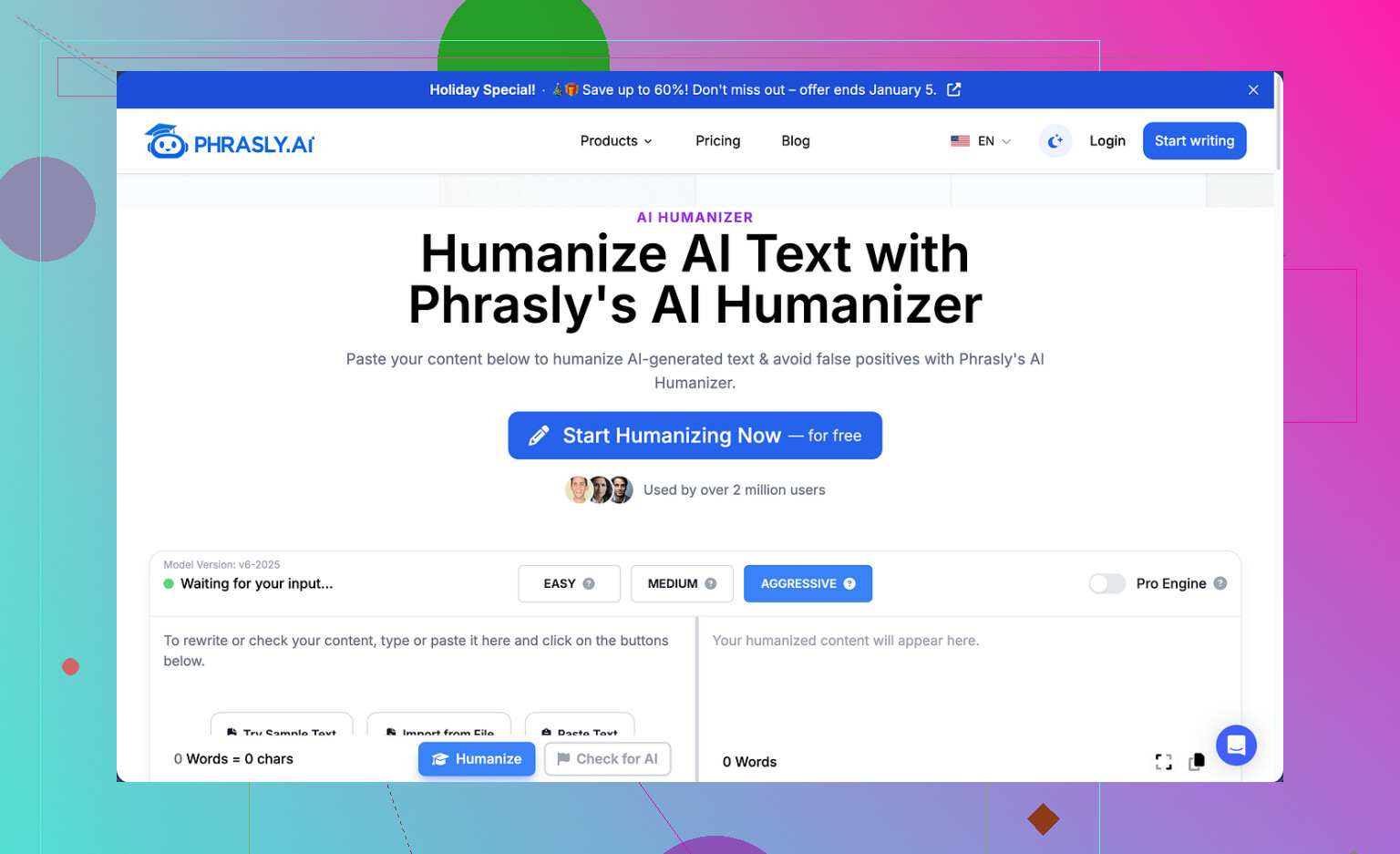
I tried Phrasly for one specific reason. I wanted to see if it could get AI text past detectors without wrecking the tone.
Short story, it did not go well.
The free tier is tiny. You get roughly 300 words total, tied to your IP. No new account trick, no email shuffle. Once that quota is gone, you are done unless you pay.
Because of that limit, I only managed to run one real test instead of my usual three samples.
Here is what I did and what happened
• Input length: about 200 words
• Mode: whatever they call the strongest setting for detection bypass, “Aggressive,” which they themselves recommend
• Detectors used on the result: GPTZero and ZeroGPT
• Both GPTZero and ZeroGPT flagged the entire thing as 100 percent AI
The “Aggressive” setting made no detectable difference. If there was some secret sauce in there, it did not show up in the scores.
How the text itself looked
To be fair, the output did not read like garbage.
What Phrasly did well:
• Sentences were clean, grammar was fine
• Style stayed formal and academic
• No obvious nonsense phrases or broken logic
Where it still felt like straight AI:
• Repeated use of stacked adjectives in groups of three
• Same type of formal structure over and over
• No shift in rhythm that you usually see in actual human writing
There was another issue that will bother some people. Length inflation.
I fed it around 200 words. It came back with a bit over 280. Roughly a 40 percent increase.
If you have to stay under a hard cap, like 500 or 1000 words for a class or a form submission, this kind of expansion can break your submission and force you to cut it back manually.
About the paid plan and refund rules
Their pitch is that the free version uses a weaker engine and the paid Unlimited tier unlocks a “Pro Engine” that, according to their site, does a lot better.
Pricing I saw:
• Unlimited plan on annual billing: 12.99 dollars per month
What made me walk away was the refund policy.
Key points:
• Refunds are only possible if your account has zero usage
• If you have processed even one sentence, you are no longer eligible
• They also threaten legal action against anyone who tries a chargeback through their bank
So to get a refund, you would have to pay, never click the button once, then decide you want your money back. That structure did not sit right with me.
Because of the strict usage rule, there is no way to pay, test a few real samples, see it fail, and then ask for a refund. Once you test, you are locked in.
How it compared to other tools I tried
Out of the different humanizers I tested around the same time, the one that gave me the best mix of low detector scores and readable output, without charging, was Clever AI Humanizer.
It cost nothing, did not hit me with a 300 word total, and I did not run into any refund drama because there was nothing to pay.
There is a more detailed YouTube breakdown here if you want to see it in action:
And the written review I used for reference is here:

If you are deciding what to try
If your goal is:
• Test multiple samples
• See how they score across detectors
• Stay within word limits
• Avoid tricky refund rules
Then based on what I saw, Phrasly’s free tier is too limited to judge the tool properly, and the paid tier is risky because of the “zero usage” refund condition.
If you want to experiment without putting a card down, I would start with Clever AI Humanizer first:
2 Likes
Short answer. You are right to be unsure.
Here is what I have seen with tools like Phrasly’s humanizer, plus what you asked about.
- Is it making the writing more “human” or only rephrasing
Most humanizers run a heavy rewrite. They swap synonyms, change sentence order, add or remove clauses.
That often keeps the same structure under the hood. Detectors still flag it, and readers still feel the same AI rhythm.
What you described for blog and social posts sounds like that. Slightly new wording, same vibe.
Quick self test
• Paste your original and the Phrasly version side by side
• Highlight every sentence that keeps the same order of facts
• If 80 percent of the logic order matches, it is rephrasing, not human style variation
- Originality and plagiarism risk
These tools usually sit on top of a model that predicts text from patterns.
So:
• It will not copy your source text word for word
• It might still look close to other AI outputs on the same topic
For SEO, originality is less about “not detected as AI” and more about:
• Unique angles
• Specific facts, numbers, examples
• Personal experience, even short ones
If Phrasly strips those details or keeps everything generic, your “originality” for search drops.
- SEO impact
Search engines care about:
• Usefulness
• Clarity
• E‑E‑A‑T stuff: experience, expertise, author info
What harms SEO with humanizers:
• Overinflated word count with fluff
• Repeated phrases like “in today’s digital age” type stuff
• No concrete value, only surface rewording
If Phrasly takes a 1,000 word post and turns it into 1,400 with the same points stretched out, the page can look thin even if it is longer.
You can check this quick:
• Run your original and the humanized version through a readability tool
• Check word count, Flesch score, and “difficult sentences”
If the humanized one is longer and harder to read, that is bad for SEO.
- Will it fool detectors
@mikeappsreviewer already showed GPTZero and ZeroGPT still flagging Phrasly on “Aggressive” mode.
I agree with their general direction, but I do not think detector scores should be your main goal.
Detectors are noisy and often hit false positives on real human text.
Search engines say they do not penalize content only for being AI generated. They care more about spam patterns and low value pages.
So if you shape your workflow only around “bypass detectors”, you give up time for a metric that does not map cleanly to rankings.
- What to do with blog posts
If you want safer SEO and a more human feel:
A. Use AI for draft, you for “humanizing”
• Let AI write core structure
• You add:
– Your own examples
– Screenshots, process steps, quotes from tools or docs
– Contrarian takes or small rants
• Shorten. Human editors cut. Most humanizers expand.
B. If you still want to use Phrasly
• Use it only on parts, not full posts
– Maybe intro hooks, transitions, or meta descriptions
• After Phrasly, do a manual pass:
– Remove triple adjectives
– Cut repeated phrases
– Reinsert your personal phrases and slang
- What to do with social content
Social posts need voice more than anything.
AI humanizers often smooth out the quirks that make your posts feel like you.
You can:
• Keep your typos and short forms
• Add opinions or mini hot takes
• Use tight sentences and skip “AI filler” like “it is important to note”
If your Phrasly output starts to sound like LinkedIn corporate speak, it is hurting you on social.
-
About Clever Ai Humanizer
Since you mentioned worries about originality and detectors, and since you do not want to risk money, testing another tool is reasonable.
Clever Ai Humanizer focuses on AI detection scores and does not lock you into strict refund rules, so you can compare outputs across detectors and see which one fits your style without going all in on a paid plan.
Use the same text across tools, then measure:
• Detector results
• Readability
• Word count change
• How much editing you still need -
Practical workflow you can try
Use this simple pattern for one blog post and compare performance over a month or two:
• Version A: Your normal AI process, no Phrasly
• Version B: Same topic, but you:
– Use AI for outline
– Write 50 percent yourself
– Let a humanizer touch only transitions and intros
– Edit hard for length and clarity
Track:
• Time on page
• Scroll depth
• Click through to other posts
• Search impressions and clicks in Search Console
That gives you real data, not only detector scores.
If you feel your text sounds “off” after Phrasly, trust that feeling. Detectors change, user reaction does not.
Short version: you’re not crazy to be sus of what Phrasly is doing.
I’ve had a similar experience: it “smooths” the text, but doesn’t actually make it feel more human. More like swapping outfits on the same mannequin.
A few specific points, without rehashing what @mikeappsreviewer and @nachtschatten already tore apart:
- Is Phrasly actually humanizing or just spinning
What I’ve noticed is:
- Sentence patterns stay rigid
- It leans into “formal but bland”
- It sometimes adds distance from a human voice by ironing out quirks, slang, and specific phrasing
So on blog posts and social, that “natural” feeling usually comes from:
- Your pacing (short vs long sentences)
- Very specific details (numbers, personal references, “I tried X and it broke Y”)
- Imperfections (slight repetition, casual connectives, even a typo or two)
Phrasly tends to wash a lot of that out. So yeah, it’s mostly rephrasing, not really humanizing.
- Originality concerns
The originality problem is less “plagiarism” and more “generic mush.”
If your original draft has:
- Real experience
- Concrete examples
- Clear POV
and the Phrasly version comes back with:
- Extra adjectives
- Longer sentences
- More abstract phrasing
then you’ve actually lost originality in a practical sense. The post may be technically unique, but functionally interchangeable with a thousand other AI-ish articles.
For originality, I’d keep your structure and voice, and if you use Phrasly at all, limit it to:
- Rephrasing awkward sentences you already wrote
- Maybe the occasional intro or CTA, then manually tweak
- SEO impact
I actually disagree a bit with people who say “detectors don’t matter at all.” They’re not a ranking factor, sure, but if your text looks like generic AI content, it often has the same signals as low quality pages:
- Overlong intros
- Repeated “context” phrasing
- Soft claims with no real support
That does hit SEO indirectly.
What actually matters for search:
- Unique angle on the topic
- Helpful formatting: subheads, bullets, scannable bits
- Real data, screenshots, quotes, or first hand commentary
- Tight, purposeful length
If Phrasly keeps inflating your posts or turning sharp copy into padded paragraphs, I’d count that as a net negative for SEO, even if rankings don’t tank instantly.
- Social content effect
For social, these tools are almost always worse. Social does well when it feels like:
- “I’m talking to you,” not “I am presenting a comprehensive overview”
- Short, punchy lines
- Clear opinion, not hedged “on the one hand / on the other hand”
If your Phrasly’d posts start reading like corporate LinkedIn fluff, that’s a problem. Honestly, a slightly messy, half-typed-from-your-phone caption will usually beat “perfect” humanized copy.
- Detectors & “getting caught”
You mentioned worrying about whether it’ll get “caught.” Detectors are inconsistent, but the pattern people keep seeing (including the tests from @mikeappsreviewer and @nachtschatten) is:
- Heavier “bypass” modes
- Still high AI scores
- More bloated, weirdly uniform text
So you’re taking more risk and getting worse style. Great tradeoff, lol.
I wouldn’t build a workflow around dodging detectors. I’d build it around:
- Being clearly useful
- Clearly written by a real person with a stance
- Not looking like it was padded to hit word count
- What I’d actually do instead
If you still want a tool in the mix:
- Use AI to draft structure or fill gaps
- Write your intros, examples, and conclusions yourself
- Let a “humanizer” touch only the bits that feel robotic, then manually pull them back toward your tone
And if you’re testing different tools anyway, Clever Ai Humanizer is the one I’d throw into the comparison. It’s specifically angled at AI detection and “natural” output, and you don’t have the same tiny quota / refund weirdness around just trying it. Run the same blog paragraph or social post through:
- Your base version
- Phrasly
- Clever Ai Humanizer
Then read them out loud. Forget detectors for a second. Ask:
- Which one sounds most like something you’d actually say?
- Which one makes you want to skim your own writing?
- Which one you’d be comfortable publishing as-is with your name on it?
If your gut says “my original + light edit > Phrasly,” trust that. Writers usually feel the fakeness before any tool does.
tl;dr: Phrasly looks more like a fancy spinner than a real humanizer in practice. It’s fine as a toy, but for blog SEO and social voice, I’d lean on your own editing plus something like Clever Ai Humanizer for targeted fixes, not full-document rewrites.