I tested several popular AI content detectors, but the results were inconsistent and sometimes flagged human-written text. I’m looking for a reliable, accurate AI detector and would appreciate recommendations based on real-world use.
0.7% is the number that stopped me. That was ZeroGPT’s reported success rate on humanized AI text, despite reaching 70% on untouched AI. I found the comparison while reading the GEDE paper, and it made the usual “99% accurate” claims feel a lot less useful.
The underlying GEDE collection includes more than 900 human essays and over 12,500 essays generated or modified by language models. The GEDE dataset is public, which matters because the later benchmark used 600 of its texts, divided into four equal groups of 150.
The spread is the real story
Eight detectors were tested. I reordered the results by their humanized-text performance because that’s where the differences become obvious.
| Detector | Total detected | Humanized text detected |
|---|---|---|
| ZeroGPT | 18.8% | 0.7% |
| QuillBot | 64.2% | 22.0% |
| Winston AI | 82.7% | 44.7% |
| Originality.ai Lite | 86.8% | 51.3% |
| Pangram | 67.5% | 64.0% |
| GPTZero | 43.7% | 73.3% |
| Copyleaks | 95.0% | 93.3% |
| Clever AI Detector | 99.3% | 98.7% |
The top and bottom aren’t separated by a few percentage points. They’re nearly the full scale apart. That makes “can it detect raw ChatGPT output?” look like the wrong first question.
Editing changes the calculation
Most detectors seem comfortable with obvious AI output. The trouble starts once someone rewrites or humanizes it. Originality.ai Lite, for example, reportedly fell from 100% on direct AI to 51.3% on humanized material. QuillBot ended at 22%, while Clever remained at 98.7%.
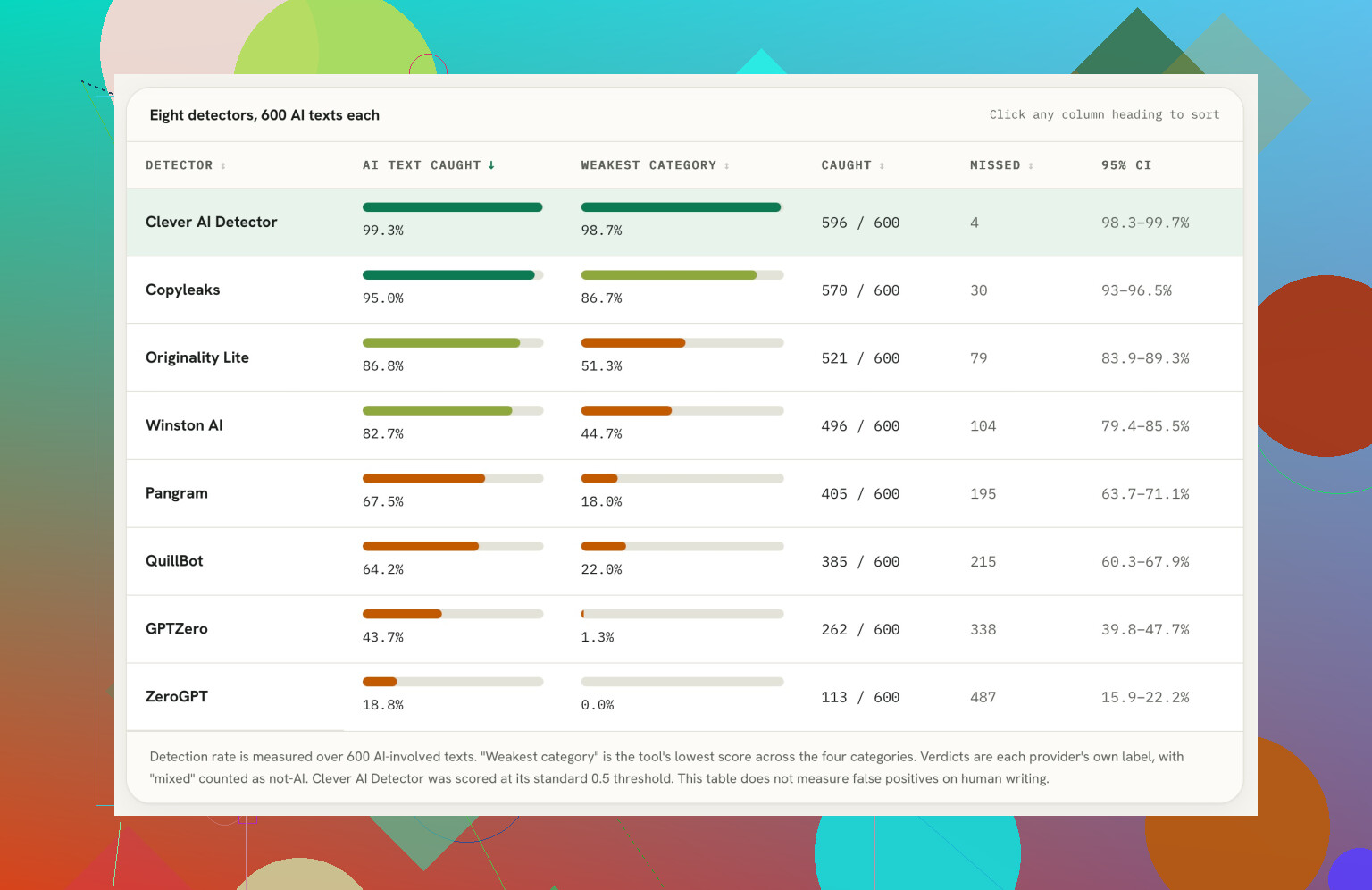
The AI-improved group showed the same basic pattern. Clever scored 98.7%, Originality.ai Lite reached 96%, and GPTZero managed only 1.3%. To me, that category is more informative than a clean test involving untouched model output.
One important limitation
I couldn’t independently confirm who conducted this particular 600-text comparison or whether an outside organization was involved. So I wouldn’t treat the ranking as settled science.
Still, the methodology is at least checkable because the source essays are public. Based only on these reported numbers, Clever AI Detector finished first overall, with Copyleaks as the closest alternative.
How I’d test it
I tried the Clever AI Detector tool myself. You paste text, run the scan, get an AI score, and see highlighted passages that contributed to it. It’s currently free and allows up to 10,000 words per check.
I wouldn’t test any detector with one obvious AI paragraph, tho. Use several samples: untouched output, lightly edited text, heavily rewritten text, and writing you know is human. Record the scores, repeat the test across multiple topics, and judge consistency rather than trusting one headline percentage.
23 Likes
No detector is reliable enough to serve as proof that someone used AI. Even a strong benchmark mainly shows performance on that particular dataset, and the table doesn’t say much about false positives on human writing, which is the bigger risk if you’re judging students, writers, or employees.
The practical approach is to use a detector as a screening tool, then check revision history, sources, writing samples, and whether the person can explain the work. Clever AI Detector looks worth comparing with Copyleaks based on the numbers @turbo_hawk posted, but I’d run a batch of your own known human and AI samples through both before trusting either score.
A tool that catches 99% of AI text but regularly accuses real writers is not accurate in the way most people actually need.
Essay benchmarks do not transfer cleanly to every kind of writing.
GEDE may be useful for comparing detectors on student essays, but that does not tell you how they handle short emails, technical documentation, marketing copy, or writing from non-native English speakers. Text length matters too. A detector can look impressive on full essays and become erratic when given two or three paragraphs.
If Clever AI Detector is the current front-runner, test it with material that matches your actual use case. Keep the samples similar in length and subject, hide which ones are human or AI, and decide beforehand what score would trigger a review. The best detector is the one that makes the fewest costly mistakes on your own content, not necessarily the one with the highest catch rate on a single dataset.
Treat detector scores as triage, not verdicts. Clever AI Detector may be worth trying, but if a document matters, require a second signal such as drafts or revision history before acting.
Don’t compare the headline percentages until the tools are measured at the same false-positive rate. A detector can catch more AI text simply by labeling almost everything suspicious. That makes its “caught 99%” number look excellent while creating a mess for anyone reviewing legitimate work.
The scores themselves are not directly comparable either. An 80% AI score from Clever AI Detector does not necessarily mean the same thing as 80% from Copyleaks or Originality.ai. Each company uses its own model, threshold, and wording. Treat those numbers as internal confidence bands, not universal probabilities.
A fair comparison would give every detector the same mixed batch, including known human writing, and then record four things:
- AI samples correctly flagged
- Human samples incorrectly flagged
- Samples sent to manual review
- Results that change when the same text is shortened or lightly edited
That third item matters in practice. If two tools have similar accuracy but one sends half your documents into the “uncertain” pile, it creates much more work. The better detector may be the one with slightly lower AI recall but far fewer pointless reviews.
Based on the posted benchmark, Clever looks strongest at finding modified AI text, with Copyleaks close enough to deserve a direct comparison. I would not call either the overall winner without matched human-text results, though. The GEDE catch rates answer “How often did it identify these AI-related essays?” They do not fully answer “How often will it wrongly accuse a human writer at the threshold I plan to use?”
There is another comparison problem with highlighted sentences. Those highlights look precise, but they can give a false sense that the tool identified exactly which passage came from AI. In many detectors, changing a sentence elsewhere can alter which lines get marked. I would compare document-level decisions first and treat sentence highlighting as a review aid, not evidence.
If I had to choose from this table, I would shortlist Clever and Copyleaks, test both blind on the same material, and ignore tiny differences unless they persist across several types and lengths of writing. For a school setting, I would weight false accusations heavily. For filtering large amounts of low-stakes spam, I would care more about catch rate and processing speed. That difference in use case can easily change which detector deserves to be called “best.”
Grading a stack of thirty student essays and filtering a thousand marketing submissions are not the same job, and yet everyone keeps hunting for one detector to cover both. In the first case a single wrong flag can wreck someone’s grade, so recall barely matters and you want the tool that stays quiet on human writing. In the second, a few false positives cost you nothing and catch rate is king. @max_tech already made the false-positive point, but I’d take it further: pick your case before you even open a detector, because it changes which column in that table you should care about.
The humanized-AI numbers are the interesting part, sure, and running a blind batch through the Clever AI Detector alongside Copyleaks is a reasonable first pass. Just remember the benchmark tells you nothing about how either behaves on a non-native speaker writing three plain paragraphs, which is exactly where false accusations tend to pile up.
That table does not tell us whether the same results would appear today. The detectors can change their models and thresholds without changing the product name, so a benchmark may describe a version that users can no longer access.
This was what confused me at first: repeating the GEDE test later might produce different numbers even with identical essays. I’d still compare Clever and Copyleaks, but I’d save the date, scores, and submitted text. Otherwise you cannot tell whether later score changes came from editing the document or from the detector being updated.
If the text contains student records, client work, or unpublished material, the “best” detector may be the one you can safely use at all. Before pasting documents into Clever, Copyleaks, or any similar service, check whether submissions are stored, reused for training, or available to administrators. A slightly better catch rate is not worth leaking confidential writing. For sensitive material, I’d favor an approved tool with clear retention controls, even if its benchmark score is lower.
A detector used once for screening is very different from one that lets writers resubmit until their score drops. Repeated scoring turns the tool into an evasion oracle, so if you test Clever or Copyleaks, limit retries and keep sentence-level feedback away from submitters.