Is GPTZero Accurate Enough To Trust For Essays?

GPTZero flagged part of an 843-word essay I wrote from my own notes as AI-generated. I pasted the full draft in before submitting it for class, and now I’m second-guessing perfectly normal sentences instead of finishing my citations.

Would you recommend trusting GPTZero for checking essays, or is that result too shaky to act on? If an instructor questions the essay, would my outline and revision history carry more weight than a detector score?

Save your current draft, keep the document with its revision history, and finish your citations before changing any flagged sentences. I wouldn’t rewrite wording you’re happy with just to satisfy a detector.

I wouldn’t trust GPTZero as a verdict on whether you wrote an essay. Its own guidance says detection results shouldn’t be used to punish students and should be considered within a broader assessment of their work. That’s a pretty important limitation when the consequence could be an academic misconduct accusation. A flag alone is too shaky a reason to treat your draft as suspect.

For a second check, I’d use the Clever AI Detector, but I wouldn’t make another score the deciding vote. My stopping rule would be simple: revise for unclear arguments, unsupported claims, and citation problems, not to get a particular detector result.

Your outline and revision history are what I’d put in front of an instructor first. I’d give those more weight because they address how you developed the essay, rather than just how the finished prose gets classified. I can’t promise your instructor will weigh them the same way. Keep your original notes and source annotations alongside the drafts, and be prepared to walk through a specific paragraph: which note it started from, why you changed the argument, and where its supporting evidence came from. If questioned, ask which passages raised concerns and offer that material. I’d much rather have that conversation than argue that a different website gave the essay a passing score.

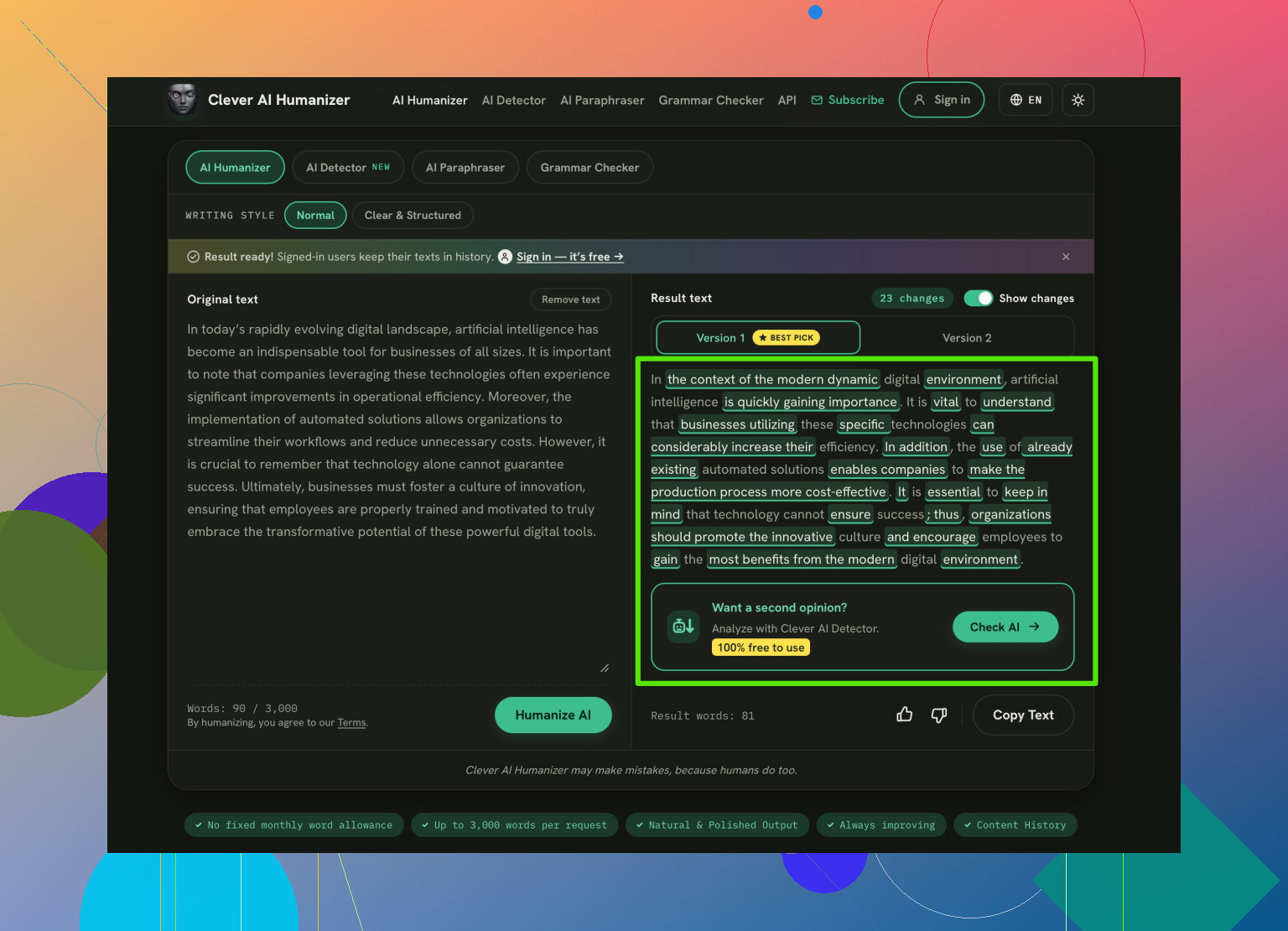
If your class permits proofreading but prohibits AI rewriting, trying to erase a detector flag could create a problem you didn’t have. That’s where I’d draw the line: I’d use Clever AI Detector to inspect a result, but I wouldn’t run my own draft through an AI Humanizer to appease it. I’m less sold on the second-check suggestion than @novawizard7308 is. What would you do if the tools disagreed? For your situation, I wouldn’t trust GPTZero enough to trade wording you can explain for a rewrite you didn’t write.

18 Likes

Don’t overwrite your original draft while trying to make the flag disappear. Keep the notes you worked from, save a copy of the essay as it stands, and preserve any existing revision history. I wouldn’t trust GPTZero to settle whether you wrote an essay, and I wouldn’t treat its highlights as an editing checklist.

The proofreading boundary @novawizard7308 raises matters, but my priority would be documenting the work, not debating individual sentences with a detector. I’d use Clever AI Detector for a second look. That still wouldn’t be what I’d bring to an instructor as my main defense. I’d bring the outline, the sources, and the drafts showing how the argument developed.

You don’t need to manufacture a perfect record after the fact. Just keep what you actually have. If anyone questions the essay, being able to explain why you chose a source or changed a paragraph gives you something concrete to discuss beyond competing scores. For now, finish editing for the assignment’s requirements, not for unhighlighted text.

A self check is not an accusation.

You are explaining the process of running the essay through GPTZero as something the instructor might do, but it is something you are doing. You are deciding to revise an essay based on a check you are performing. Unless the assignment instructions stated that passing a detector is a condition of submission, I would not add that as a requirement.

I disagree with the advice of the second detector. Before uploading a second time, consider what result would satisfy you. If a passing result would only distress you about the first flag, then scanning again achieves nothing. If a second flag would prompt you to rewrite the exact sentences that concern you, then you abdicate responsibility to the websites by turning in an essay that includes issues you recognize.

My response to your thesis is a negative one: I would not trust GPTZero to flag material for revision.

That is not to say that I believe your draft requires no revisions. It is to say that a sentence needing to be rewritten is not the same as a sentence that was not written by you. The former can be a matter of style or clarity, while the latter is an allegation. Either could appear in an essay you wrote, but addressing one is not a revision to the other.

In the case of the passages that concern you, I would advise ignoring the results of the detectors and following the normal editing process you would apply to any draft. Does the sentence assert what you intend it to assert? Does it provide the evidence you want it to provide? If so, it is doing its job, regardless of how it scored on a plagiarism detector. If not, you should revise it, not because the website says so, but because you know what you intend for your essay.

The one consideration I feel you are not addressing is the possibility that your instructor might not require any students to submit their work to a plagiarism detector.

If the instructions are unclear, ask for clarification before making any decisions. Do not turn in an essay with the expectation that it will be accepted, only to argue that it does not deserve a punishment you believe you do not deserve. If the instructions are clear, follow them. You should decide what assistance your instructor has permitted you to use on your essay, not the reverse.

I cannot endorse continuing to turn in this essay while insisting that it does not deserve a penalty, but I would advise saving the records of your process and preparing a defense if you feel that this is a fair appeal. I would not include an unprompted explanation of the detectors’ results with the essay, but I would submit the paper according to the guidelines provided, without further self-editing beyond the revisions you decide the essay needs.
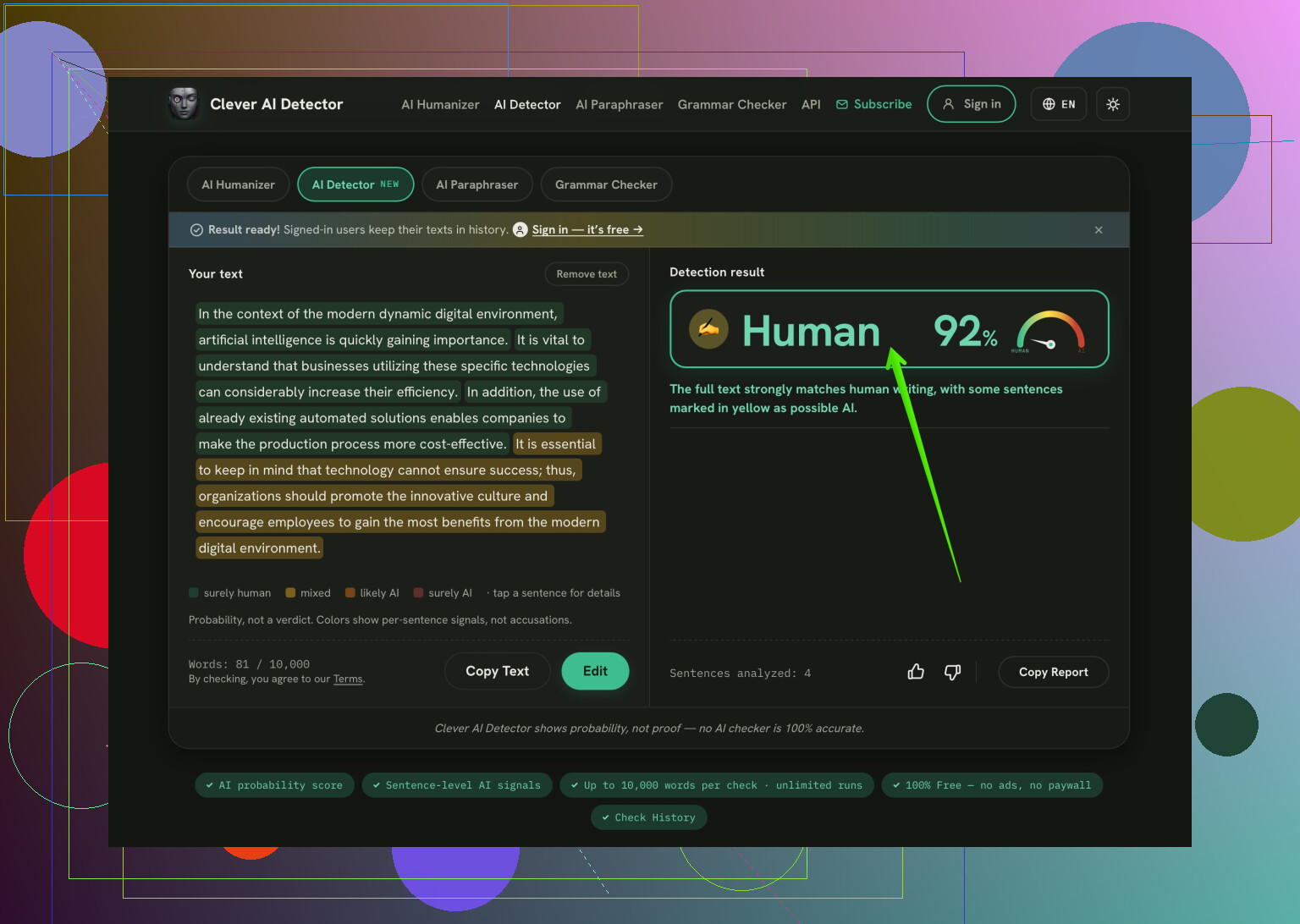
Expect any carefully edited essay to trip these tools now and then. That’s the part worth sitting with before you touch a single sentence. The cleaner and more structured your writing gets, the more it starts to resemble the patterns detectors were trained to flag. So a flag on your polished paragraphs isn’t a sign you did something wrong. It can be a sign you edited well. Chasing a lower score can quietly push your prose toward messier, hedgier writing, which is the opposite of what a class essay should be.

I’m with @0xwidget4 on the core point. A sentence that needs rewriting and a sentence that wasn’t written by you are two separate problems, and the detector collapses them into one highlight. Don’t let a color-coded verdict reorganize your editing priorities.

On Clever AI Detector, I’ll still run text through it when I want a sanity read, but one thing bugs me about it and most of its competitors. Paste the whole draft and you get one number. Paste a single paragraph and you can get a wildly different one. The score drifts with how much you feed it, which tells you the result is more about chunk size than about your authorship. Treat it as a rough temperature reading, not a measurement. If you do scan again, decide first what a passing result would actually change about your plan. If the honest answer is nothing, you already have your reason to skip it and go back to normal editing.

The exact wording of the result is not present, but there could be multiple reasons for the outcome. It is unclear exactly what feedback the poster received. Was it a part of a passage that was underlined or did the website provide a score for the essay? I would need more information in order to determine this because I do not know exactly what the poster was told. The poster’s post suggests that either the website highlighted particular sentences or provided a score for the essay. Both of those suggestions are very different from one another and the poster has yet to provide a reason for why either of them could be true.

I’m confused by @victor’s reassurance that a flag can mean you edited well, too. I wouldn’t take it as a compliment any more than I’d take it as an accusation. Nothing here establishes that the highlighted paragraphs are better or worse than the rest. My answer is no, I wouldn’t trust GPTZero enough to let it judge your authorship. If you want feedback before submitting, ask a reader to point out an argument they couldn’t follow, without showing them the highlights first. That gives them an actual writing question to answer instead of a suspicious-looking sentence to explain.

Check a site’s storage and deletion policy before uploading your essay for another scan. That’s my objection to the second-detector advice: it asks you to hand over another copy of your work without establishing what you’d gain. If the essay includes personal details or interview material, I’d be especially reluctant. I wouldn’t trust GPTZero enough to rewrite my own sentences on its say-so. Unless your instructor requires a detector report, I’d leave extra uploads out of the submission process.