I installed the Cleanup app to remove unwanted objects from my photos, but it asked for full access to my photo library. I’m worried about privacy, data collection, and whether my images could be uploaded or stored on their servers. Can anyone explain how safe this app is, what its privacy policy really means, and if it’s okay to grant it photo access?
Cleanup App (Phone Storage Cleaner) – personal take
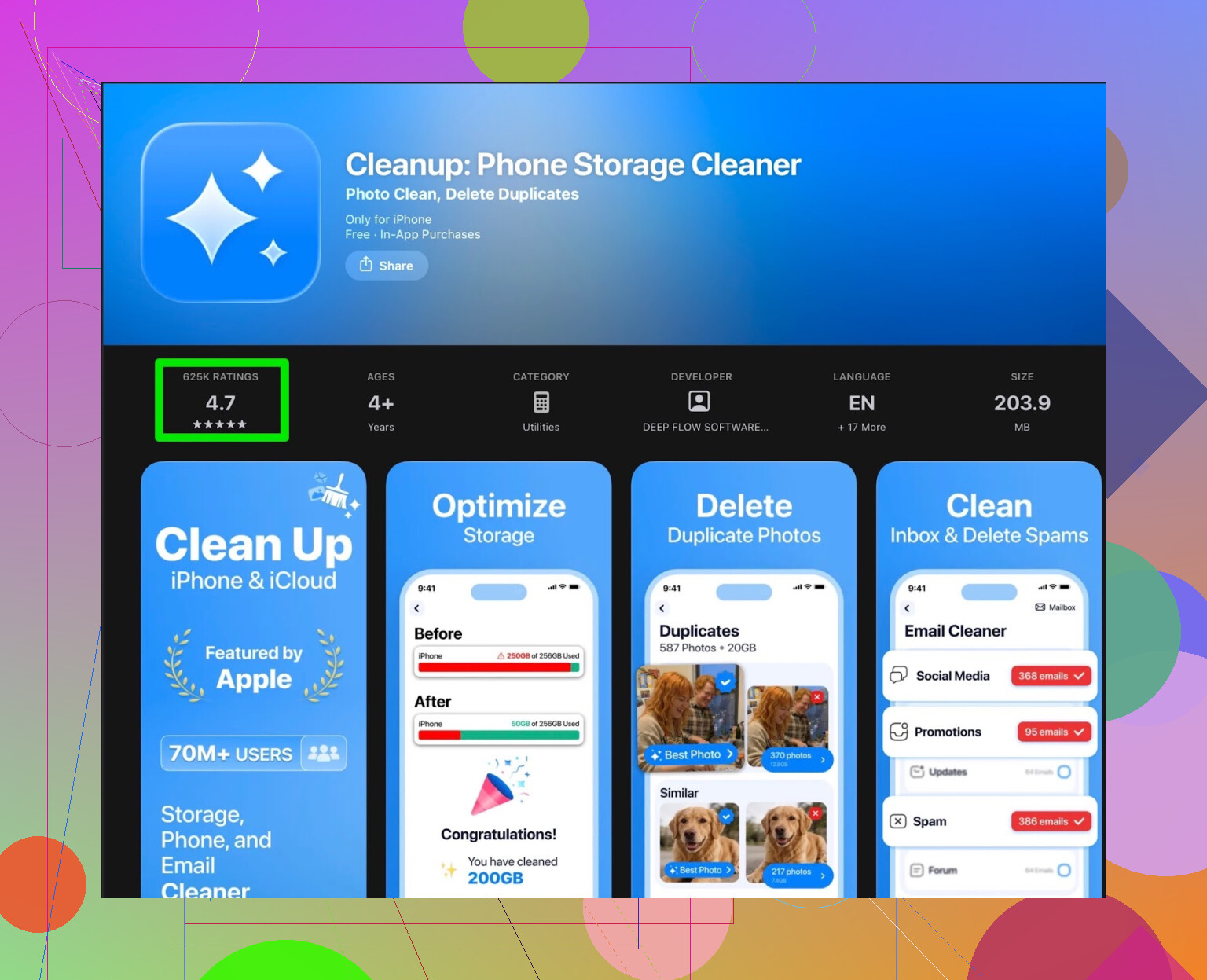
I hit the classic iPhone wall: “Storage Almost Full” every few days. I was tired of deleting 20 photos, getting back 300 MB, and then seeing the warning again the same week. So I tried Cleanup App (Phone Storage Cleaner).
Here is what it did right for me:
- Scans for duplicate photos
- Groups “similar” photos together
- Finds screenshots
- Shows big videos
- Has options to merge duplicate contacts
- Offers video compression to save space
So on paper, it ticks the right boxes.
Reality was less fun.
The scan ran fine. It did find a lot of old screenshots and multiple takes of the same picture. The problem started when I tried to fix things.
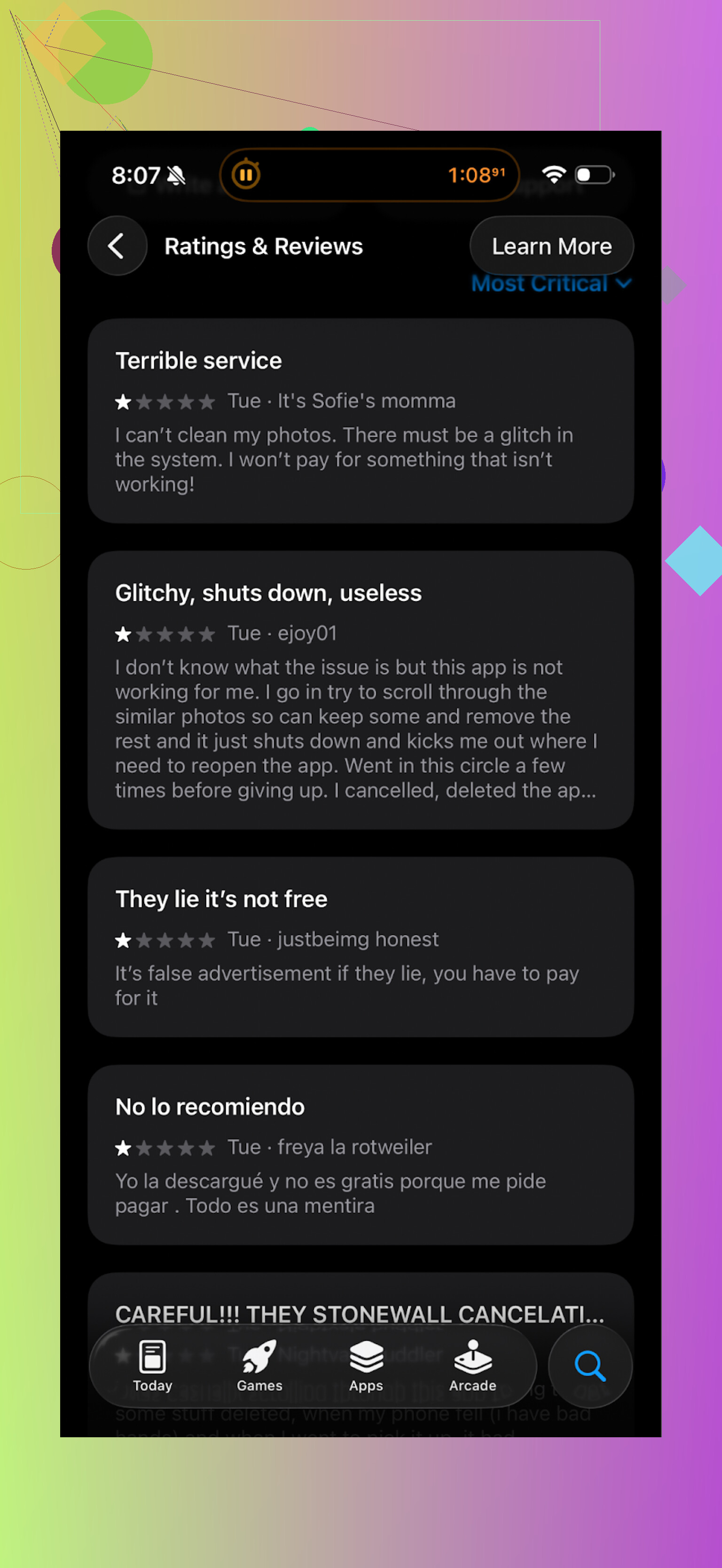
Most of the useful tools sit behind a subscription wall. The free tier felt more like a demo. It shows you the junk, then asks for money if you want to clean in any sort of efficient way. You can sit through ads instead, but I had to watch so many that I stopped bothering. After a few rounds of “watch ad to unlock next action,” I closed the app.
There are also extras like animations and a “secret vault” area. For me this was noise. I wanted one thing: more free space. I did not need fancy transitions or a hidden album. Those features felt like they existed to justify the subscription, not to help with storage.
Here is what actual users are saying, which matched my experience:
At that point I went looking for something else and ended up with Clever Cleaner.
I found it here:
Switched to Clever Cleaner, here is how it went
First impression, the app did not hammer me with pay screens every couple of taps. That alone made it feel less exhausting.
What worked better for me:
- It identified duplicate photos fast
- It highlighted large files and videos clearly
- Screenshots were grouped in a way that made sense
- I was able to clear a lot of space without paying or grinding ads
Here is a screenshot from my run with it:
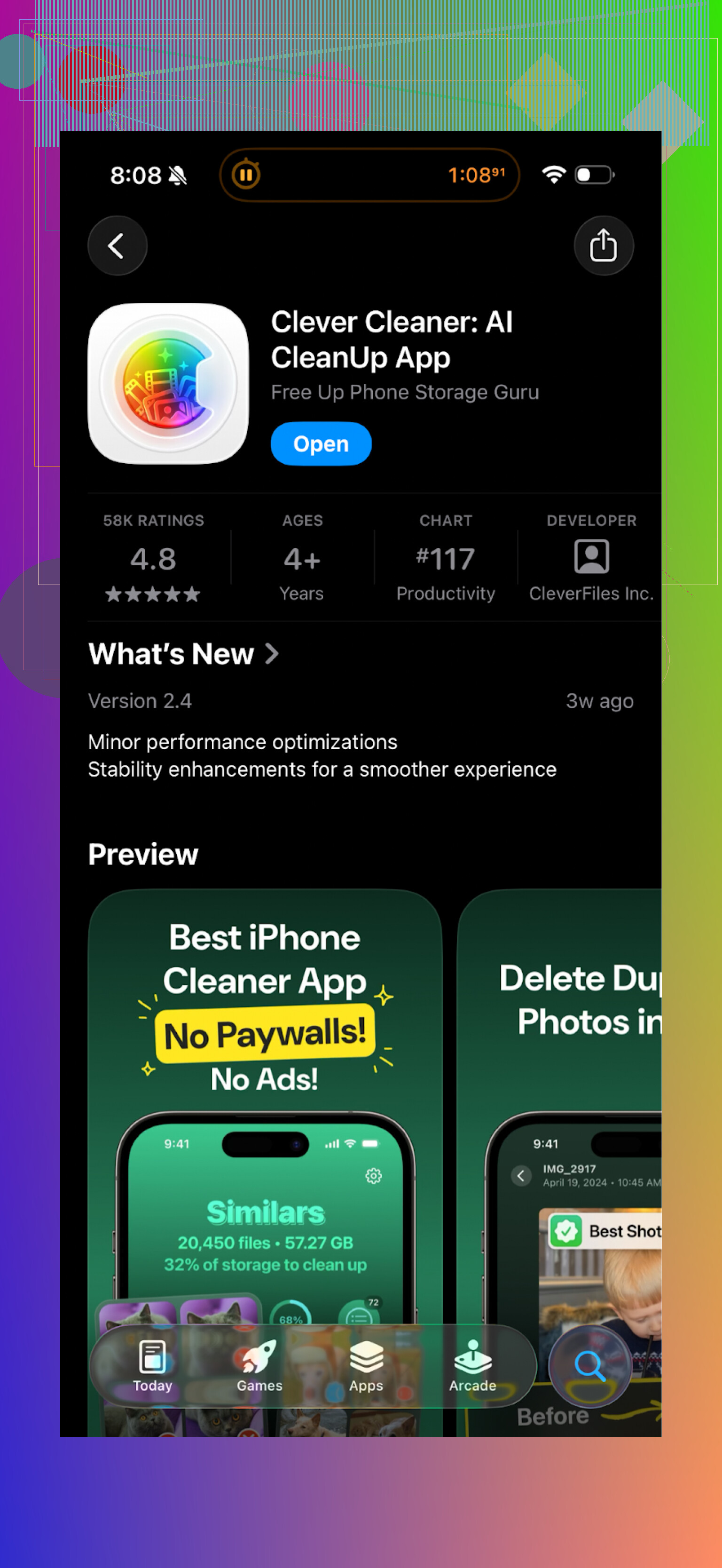
I got back a few gigabytes in under 15 minutes by nuking old WhatsApp media, screen recordings, and years of random screenshots. I did the review step manually before deleting, because those “similar photo” algorithms are not perfect. In my case, it flagged some photos of notes and documents as “similar” when I wanted to keep all of them. So double check before you confirm.
Comparison from my own use
Cleanup App (Phone Storage Cleaner)
Pros:
- Decent scanner
- Picks up duplicates, similar photos, and contacts
- Interface is not confusing
Cons:
- Heavy subscription focus
- Free version is limited for actual cleanup
- Too many ads if you try to use it without paying
- Extra features that do not help much with freeing storage
Clever Cleaner
Pros:
- Less aggressive about payments
- Faster scan on my iPhone 13
- Lets you remove duplicates and big files without feeling blocked
- Simple flow: scan, review, delete
Cons:
- Still need to review results so it does not delete things you care about
- Interface is a bit plain, but that did not matter to me
If your main goal is to free up storage and you do not want to deal with constant paywalls, Clever Cleaner was the better experience for me.
Video and links
You can see it in action here:
Official homepage:
App Store link:
Quick tips from using both apps
- Run the scan, but always review results before deleting
- Pay special attention to “similar” photos, not only “exact duplicates”
- Sort big videos by size and start from the top
- Clean out old screenshots every month so you do not end up in storage panic again
- Export important photos to iCloud, Google Photos, or a computer before any bulk delete
If you are stuck on “Storage Almost Full” all the time, something like Clever Cleaner helped me get my phone back under control without playing the subscription game every session.
20 Likes
Short answer, you are right to be cautious.
A few concrete points to help you decide:
-
What “full photo access” means
On iOS, if you tap “Allow Full Access,” the app can read every photo and video in your library.
It does not mean it auto uploads everything, but it gives the app permission to do so if the developer built it that way. -
Check if Cleanup processes on device
Open the App Store page of Cleanup.
Scroll to “App Privacy.”
Look at “Data Linked to You” and “Data Not Linked to You.”
If you see “Photos or Videos” listed under “Data Linked to You” or “Identifiers,” it likely sends some data to their servers.
If they say “No data collected,” then most processing should be on device.
Many object removal apps send images to a server for AI processing, which is the main privacy risk. -
Read the privacy policy for two things
Search for:
• “upload,” “store,” “image,” “photo,” “server”
• “third parties,” “advertising,” “analytics”
Red flags:
• Photos used for “service improvement” or “analytics”
• Data shared with “partners” or “ad networks”
• No clear retention period for uploaded images -
Use “Selected Photos” if possible
On iOS you can tap “Selected Photos” instead of “Full Access.”
Then only pick the photos you want to edit.
If Cleanup refuses to work without full access, that is a design choice, not a technical requirement.
For an object remover, there is no strong technical need for full library access. -
About uploads and storage
If the app is AI heavy and does background processing, there is a good chance edited photos go to a server, at least temporarily.
The questions you want answered in the policy or FAQ:
• Are photos uploaded at all
• Are they stored or deleted after processing
• Are they used to train models
If the answers are vague, treat that as “assume upload + storage.” -
What I slightly disagree with from @mikeappsreviewer
They focus more on subscription pain and storage cleaning.
Your concern is privacy. I would not trade full-library access for some automatic cleanup if the policy looks aggressive, even if the app is smooth to use.
For privacy, I prefer fewer features and clearer data handling. -
Safer workflow idea
• Turn on iCloud Photos or back up to a computer.
• For sensitive images, keep them in a separate, offline place.
• When you want to edit with Cleanup, copy only non sensitive photos into a temporary album.
• If possible, give Cleanup “Selected Photos” access to only that album.
• Revoke access later in Settings > Privacy & Security > Photos. -
Alternative tools
If your main issue is storage and duplicate junk, not object removal, I would look at something like the Clever Cleaner App instead of another tool that pushes heavy AI on your images.
It focuses on duplicates, large files, WhatsApp media, and similar, and you avoid sending your whole camera roll to a remote server for complex edits.
Use system features like iOS “Duplicates” album in Photos plus Clever Cleaner App for cleanup, then a more privacy clear editor only when needed.
If you feel unsure after reading the Cleanup privacy policy, assume your photos might be uploaded and stored and limit access to non sensitive images.
Short version: I would not give Cleanup full photo access unless you are totally fine with the possibility that your images might be sent to their servers and kept longer than you expect.
A few things that have not been said yet:
-
Object removal almost always means server-side AI
If the app is really good at erasing objects, there is a decent chance it is using a cloud model, not just on-device processing. Apple’s own tools do some magic locally, but many third-party apps take the “upload → edit on server → send back” route because it is cheaper and easier for them.
If the dev is not loudly bragging about “on-device only” or “we never upload your photos,” I assume some upload is happening, even if it is “temporary.” -
“Full access” is a product design choice
For what you want, the app only needs access to the specific photo you are editing at that moment. If it “requires” full-library access to even open, that is more about convenience and data access than any hard technical need.
Personally, this is where I start to back off. Not because it is definitely malicious, but because it shows the dev prioritized frictionless access over minimizing your exposure. -
Data collection is not always obvious
Even if they do not “store your photos forever,” they can still:- Log metadata (device, time, rough location, identifiers)
- Keep failed uploads or error samples
- Store some images for “quality improvement” of their AI
A lot of privacy policies sneak that into one vague sentence. If you cannot find a clear statement like “we delete images immediately after processing and do not use them to train our models,” assume the opposite.
-
Why I treat this differently from storage cleaners
@mikeappsreviewer focused more on how annoying Cleanup is to use for storage and mentioned switching to Clever Cleaner App instead. That is actually a different threat model: a cleaner mainly needs thumbnails and metadata to group junk; an AI object remover needs the full image contents and often higher resolution.
@nachtdromer already pointed out the “Selected Photos” trick and some policy reading tips. I’d add: if an app is primarily about editing and not about sorting, I hold it to a higher privacy bar, because the value of each photo is higher and more personal. -
My practical rule of thumb
- Banking info, kids, bedroom, IDs, medical stuff: never through a generic cloud-based editing app.
- Travel pics, food, landscapes: if I must, maybe, but I still prefer tools that are explicit about local-only processing.
- If the app hard-blocks you from using “Selected Photos,” I uninstall and move on. That is my red line.
-
What I actually do instead
For storage / duplicate cleanup: I use system tools plus something like the Clever Cleaner App. It focuses on duplicates, large files, and screenshots without demanding my entire library for AI tricks. For me that’s a better balance: I get space back without sending a stream of high-res personal photos through someone else’s servers.
For object removal: I use more transparent editors or desktop tools where I have tighter control over what leaves my machine.
So, is Cleanup “safe”? It might not be actively evil, but from a privacy-first standpoint, any app that (a) wants full access, (b) does heavy AI work, and (c) is vague about uploads is a “treat as risky” in my book. If you are already worried, that is your gut telling you not to hand over the entire camera roll.
Short version: if you already feel uneasy giving Cleanup full library access, you probably should not. Your instinct is usually a better privacy filter than any app blurb.
Analytical take, building on what others said:
-
The real risk is scope, not just “can they see my photos”
You are not just granting access to the one sunset you want to clean up. You are potentially exposing: family pics, IDs, medical shots, private chats screens, location-rich travel photos. If a future update changes how Cleanup behaves, that entire archive is within reach the moment you tap “Allow Full Access.” -
“We don’t upload everything” is not the same as “we can’t”
A point I mildly disagree on with the more optimistic readings: it is not enough that the privacy page currently says they do limited collection. With full library access, a silent feature flip in a later version could start uploading thumbnails, metadata, or certain photo types without a new permission prompt. The platform permission does not re-ask you for nuances. -
Local vs server AI is a spectrum, not a binary
Even if some processing is on-device, the app can still:- Send a compressed version of the image for “enhanced” cleanup
- Upload only edits that fail locally
- Keep “hard examples” to improve models
None of that shows up clearly in the UI. This is why vague wording in the policy is a bigger problem here than in a simple gallery or notes app.
-
What I would do specifically with Cleanup
Different from what @nachtdromer and @sonhadordobosque focused on, I would:- Refuse full-library access as a default policy for any heavy AI photo editor.
- Only use “Selected Photos” and, if Cleanup breaks or nags aggressively, treat that as a design red flag and uninstall rather than “give in once.”
- Assume anything you pass through it could end up in a training set unless the policy clearly says it never will.
-
Tradeoff question: object removal vs peace of mind
Ask yourself bluntly: “Is removing that random tourist from my vacation photo worth accepting the worst-case scenario of a cloud copy of my kid’s birthday, my passport picture and my medical photos existing on some third-party server for an undefined time?”
If the answer is “no” even once, then full-library access is not worth it. You can live with slightly messier photos. -
Where the Clever Cleaner App fits in
A few people talked about subscriptions and nag screens. My angle is risk surface. A cleaner that mostly deals with duplicates, WhatsApp junk and large videos has a narrower target: it is not trying to transform the content of each frame with AI, it is just grouping and flagging. That is inherently a little less sensitive than a tool whose main purpose is to deeply analyze and reconstruct each image.Pros of Clever Cleaner App in this context:
- Focuses on storage cleanup, not aggressive AI editing of individual shots
- Lets you quickly reclaim space by removing duplicates, similar images and big files
- On typical usage, you are interacting with lists and thumbnails rather than sending each personal photo through a black box “magic eraser” pipeline
Cons to keep in mind:
- It still needs access to your photos to do its job, so it is not a zero-risk option
- “Similar photo” detection can surface private content you forgot you even had, so you still need to review carefully
- The privacy comfort mainly comes from narrower goals, not from some magical immunity to data collection
Relative to the Cleanup app, I would be more comfortable using Clever Cleaner App for bulk cleanup and then doing any really sensitive object removal with tools where I can control the environment better, such as desktop software that works offline.
-
Practical split-strategy that avoids overthinking every permission
Instead of hunting for the one perfect safe app, separate tasks:- Use a cleaner like Clever Cleaner App or built-in system tools for “housekeeping” (storage, duplicates, large files).
- Keep a different tool for serious edits. For anything remotely sensitive, prefer an editor that clearly documents local-only processing or a desktop program where you can cut off the network completely.
Once you look at it this way, the question “Is Cleanup safe to give photo access to?” morphs into “For this kind of invasive edit, do I want to give any mobile app full, continuous visibility into my entire life history in pictures?”
If you are hesitating, that is already your answer.