I’m working on a project where I need my writing to sound human, but I’m worried it might be flagged as AI-generated by detection tools. Are there methods or tools to check whether my content gets detected as AI? Any tips to avoid false positives would be really helpful.
Honestly, AI detection tools are getting more popular, but they’re not perfect—tons of false positives and a lot of variability. If you want to check if your writing gets flagged as AI-generated, you can run your text through online detectors like ZeroGPT, GPTZero, Copyleaks, or Originality.AI. They all have slightly different algorithms and thresholds, so don’t panic if one flags your content while another doesn’t.
One quick trick: AI text often repeats phrases and avoids contractions or idioms, so sprinkle in stuff only a real person would say. Edit for voice and quirks—use “I reckon” or ask questions. Shorter sentences and varied punctuation make things look less robotic too.
If you’re tired of playing whack-a-mole with the detectors, tools like Clever AI Humanizer can help by tweaking your writing’s phrasing and rhythm, making it sound much more like a real person wrote it. Seriously, it takes out a lot of the headache and keeps your style intact. Give it a look at make your AI-generated text sound truly human—it’s actually pretty handy for flying under the radar.
Final note: None of these tools are foolproof. If it’s super important (like for school or work), always add your own edits and personal touches after using any humanizer or paraphraser!
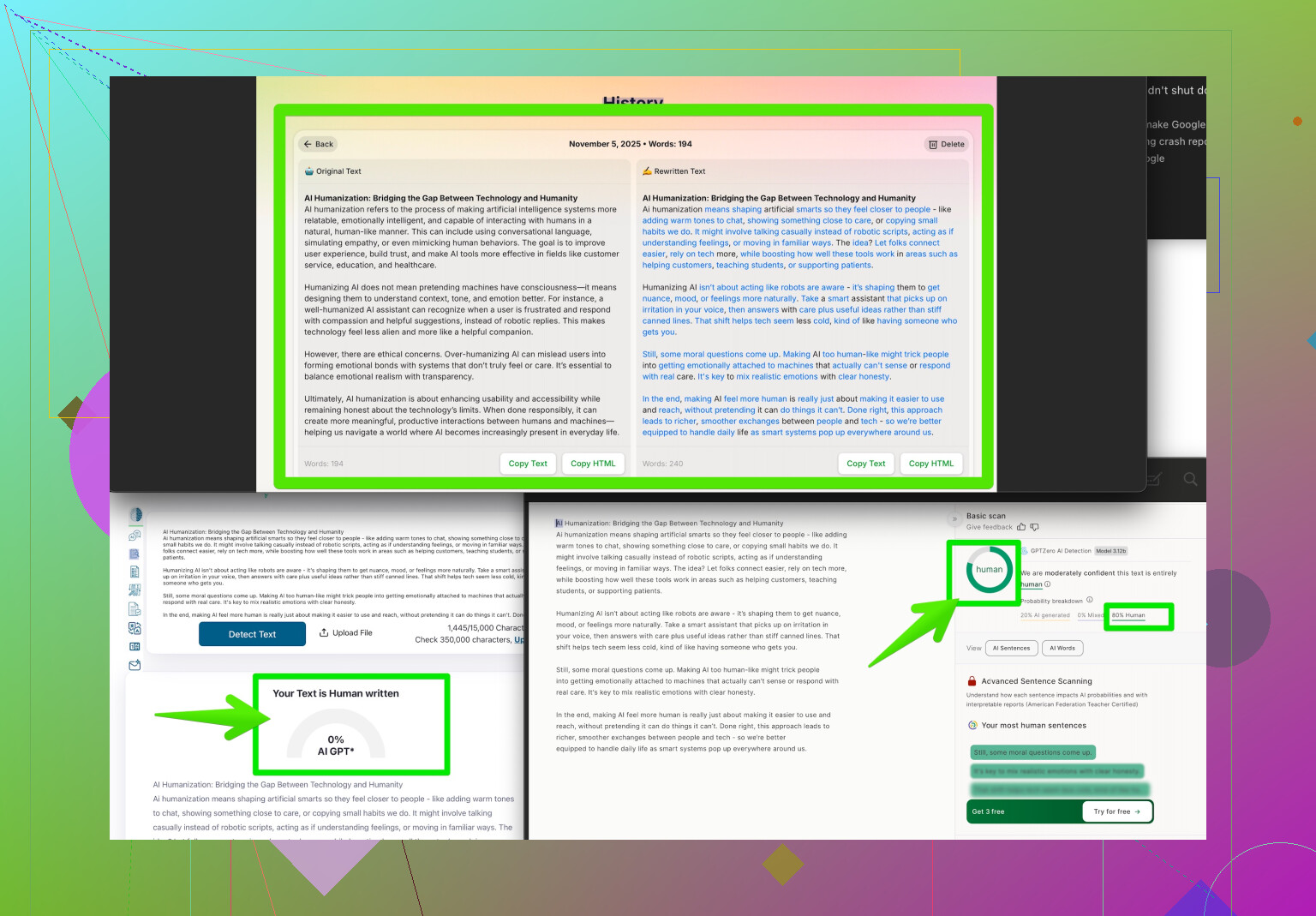
Not gonna lie, there’s a lot of noise out there about “beating” AI detection and, honestly, sometimes it feels more like chasing ghosts than anything else. Sure, @sterrenkijker covered the usual gauntlet of AI detectors and those online tools, but here’s the thing: the more you obsess about fooling these algorithms, the faker your stuff might actually sound. It’s like trying to sound “normal” when you’re on the phone with your boss and then suddenly you forget how humans talk.
Here’s the scoop: AI detectors look for more than just repetitive phrases and lack of idioms—they’re trained on patterns in sentence structure, probabilities, and even rhythm. Some have even started flagging texts for being too organized or weirdly neutral (because, y’know, AI never gets passionate or opinionated). So, ironically, making a few random typos, dropping in super niche references, or rambling off-topic can make your writing seem more “human.” It’s not about writing badly, just showing character.
If you want to get real sneaky, read your text out loud after you write it. When something sounds off—boring, stiff, or just too polished—change it. That’s the stuff these detectors often pick up on. Another trick? Ask a friend to scan it. Humans (at least the ones I know) catch weird AI hints way better than detectors sometimes.
Lastly, don’t overinvest in all-in-one fixers, but if you hate manual editing, Clever AI Humanizer honestly does a solid job giving content a more human feel without making it sound like Shakespeare on a caffeine bender. Just don’t rely on it blindly. AI tools can only get you so far; a real personal touch beats them every time.
And for more practical advice from actual writers and users, check out what people are sharing about making AI content sound more natural on Reddit at real-world humanizing strategies for AI text.
Bottom line: every detector is imperfect. Don’t lose sleep if you trip up one or two—odds are your audience won’t catch it unless you’re submitting a thesis on the Turing Test.
41 Likes
Let’s get real: AI detection is basically the arms race of the year. While ZeroGPT, Copyleaks, and GPTZero get name-dropped a lot (rightly), there’s one thing everyone seems to agree on—none of these tools are bulletproof, and sometimes the best move is to write like you mean it instead of endlessly overhauling to sidestep algorithms.
What does make a difference? Bringing your quirks to the table: rant a bit, drop a hot take, toss in stuff you overheard at lunch, or just go off-script. Spontaneity: 1, Robot overlords: 0. If you want hard data, most detectors are trained more to spot pattern predictability and structural blandness than actual intent, which means even “clever” AI outputs can get flagged if they’re too tidy.
That said, I can see the appeal of auto-humanizers—Clever AI Humanizer in particular actually stands out for how well it retains nuance and (mostly) doesn’t junk your unique phrasing. Pros: saves serious time, adapts tone well, doesn’t rewrite everything Shakespearean-style. Cons: sometimes it over-“quirks” the text or misses context-specific idioms, and—let’s be honest—nothing beats a real round of manual edits for mission-critical stuff. But next to stuff like Originality.AI or the rewriting features in big AI dashboards, it’s less robotic and more, well, clever.
Bottom line: borrow pro tips from those detectors, automate with Clever AI Humanizer if you’re on a deadline, but always add yourself back in last. If detectors get fooled, cool. If not—don’t sweat it unless your audience is literally the Nobel committee.
You covered detectors like ZeroGPT, Copyleaks, GPTZero, and a humanizer, plus the idea of writing with quirks. You noted false flags from tidy, predictable text.
Simpler path: speak first. Record a 2 minute voice note on your phone. Transcribe with built in dictation. Edit lightly. This keeps rhythm, hesitations, and idioms. Example: outline 3 points, talk once through each. Aim for 70 percent short sentences. Avg sentence length 14 to 18 words. Run a readability check, target Grade 7 to 9. Fix glaring typos, leave a few natural stumbles. Feels human, dodges teh over-polish.