I’ve seen a lot of mixed reviews about Clever AI Humanizer and I’m trying to figure out if it’s actually worth using for long-form content and client work. Some people say it’s great for bypassing AI detectors, while others claim it hurts readability and sounds off to real readers. Can anyone who has used it share real, no-hype experiences, including pros, cons, and whether it’s safe and effective for professional use?
Clever AI Humanizer: Actual User Walkthrough, Not Hype
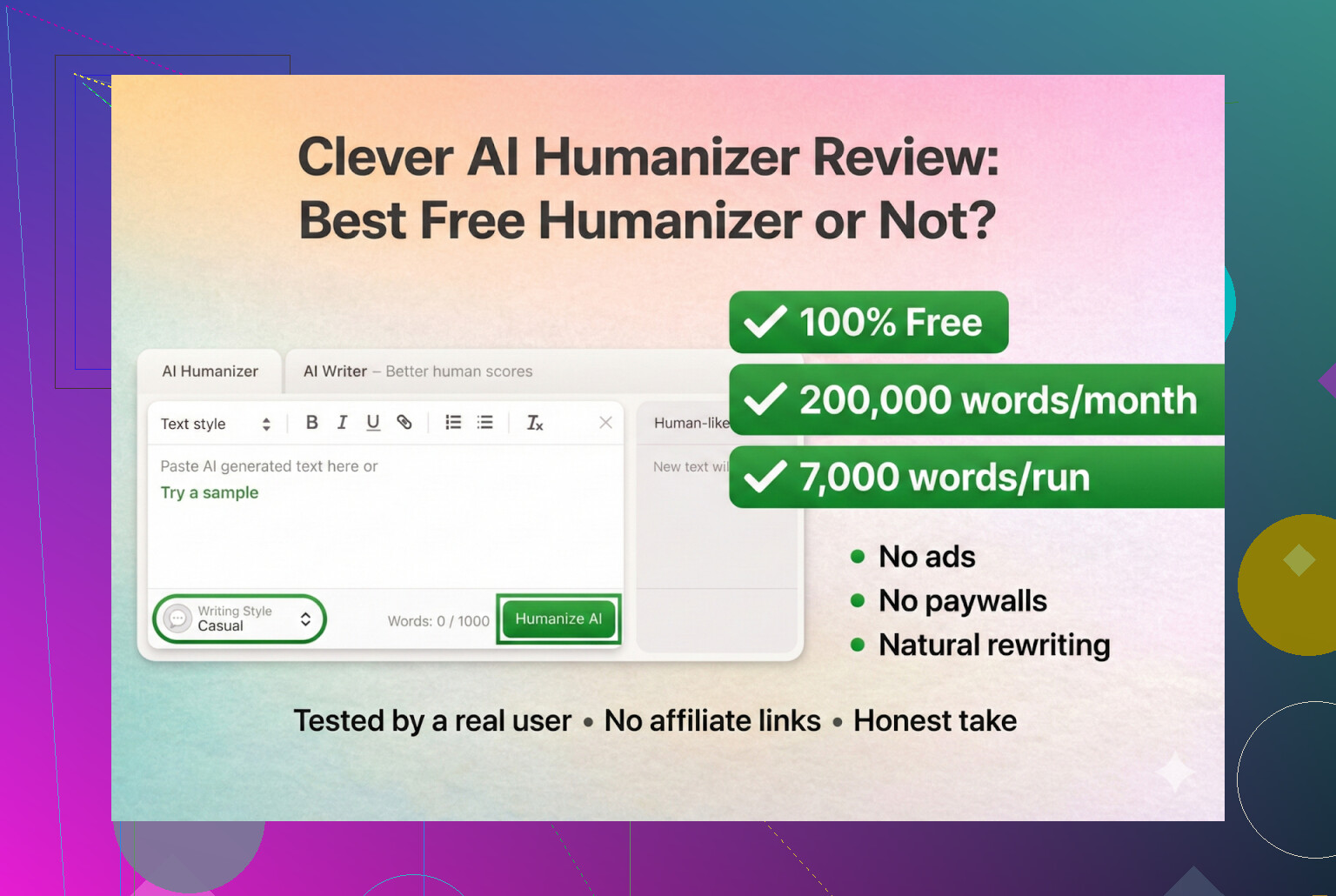
I’ve been messing around with “AI humanizers” for a while, mostly out of curiosity and a bit of paranoia about detectors. A lot of them are either clones of each other, straight-up trash, or aggressively trying to sell you a subscription after 3 clicks.
So I decided to properly test Clever AI Humanizer using an AI-only setup and see how far it can really go.
Official site (this matters, I’ll explain):
https://aihumanizer.net/
Quick note so you don’t get scammed
There are a bunch of tools using “Clever” or “Humanizer” in their name, buying ads on Google and pretending to be this one. People DM’d me asking which one was the “real” Clever AI Humanizer after they accidentally signed up for some paid plan somewhere else.
Important details based on my experience so far:
- Real Clever AI Humanizer: https://aihumanizer.net/
- It has no paid tier, no subscription upsell, no “unlock premium” nonsense.
- Some other sites are clearly piggybacking on the name and popularity.
If you are being asked for a credit card, you are not on the real one.
How I tested it
I didn’t write a single line myself at first.
- Asked ChatGPT 5.2 to generate a fully AI-written article about Clever AI Humanizer.
- Took that raw AI text and dropped it into Clever AI Humanizer.
- Chose the Simple Academic style.
- Ran the output through a few popular AI detectors.
- Then asked ChatGPT 5.2 to analyze the humanized result.
Why Simple Academic? Because that style is usually where tools fall apart:
too stiff and it screams “AI,” too casual and it fails academic-ish flows. This mode sits awkwardly in the middle and is hard to get right.
Simple Academic mode: what came out
Mode used: Simple Academic (not hardcore academic, more like “college essay that cares a little about structure”).
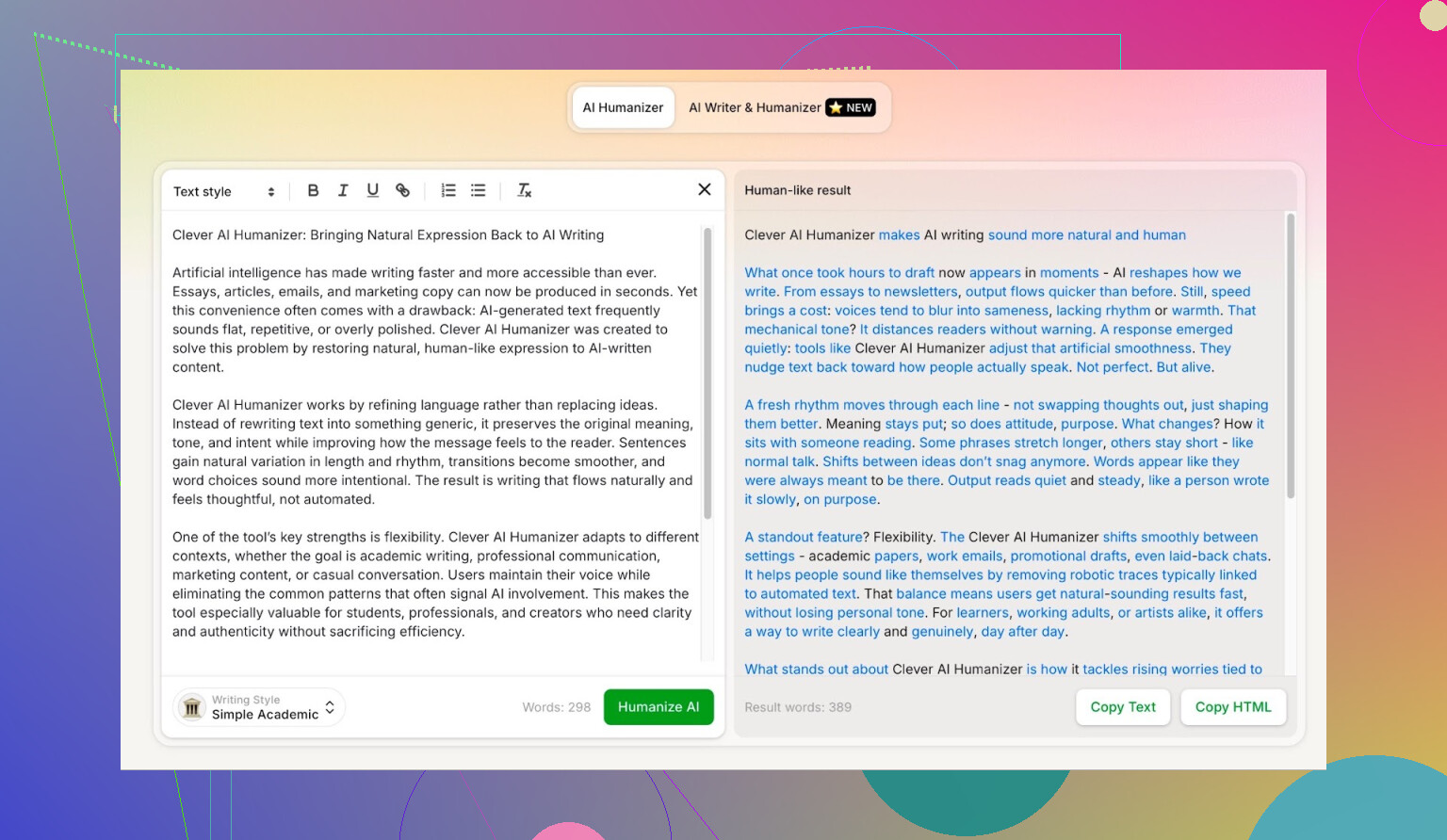
The idea seems to be: keep the tone formal-ish but not robotic, and slightly tweak patterns to dodge detectors without completely rewriting the soul out of the text.
Now, numbers time.
Detector results: ZeroGPT & GPTZero
First detector: ZeroGPT
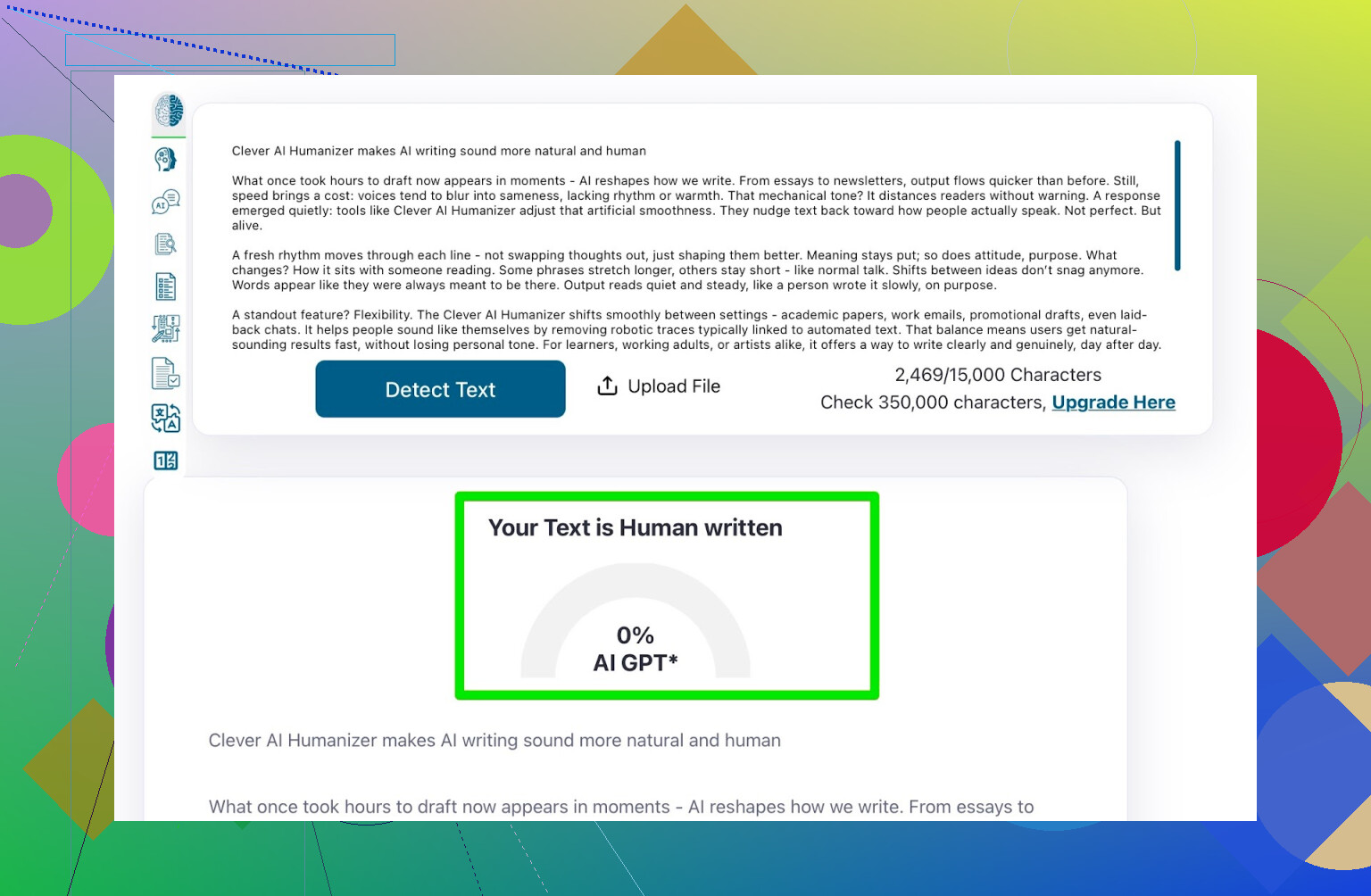
I don’t put a ton of faith into ZeroGPT, because it once flagged the U.S. Constitution as 100% AI, which is hilarious and also tells you how jittery these tools can be. But it is popular and ranks high, so I used it anyway.
- Result for the Clever AI Humanizer output:
0% AI
Detected as fully human.
Second detector: GPTZero
Same story:
- Result: 100% human, 0% AI
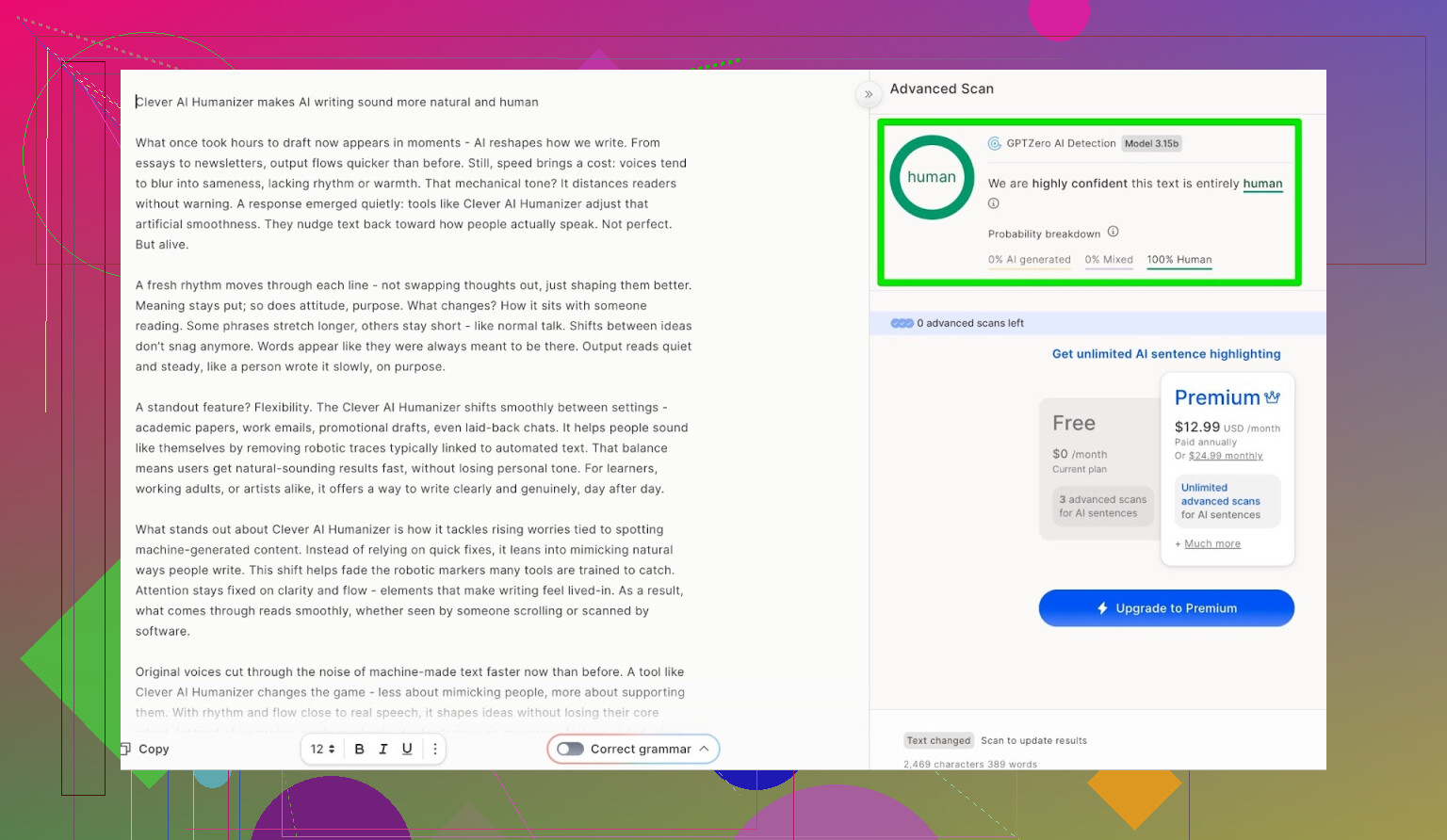
On paper, that’s basically a perfect score across the 2 most used detectors.
But is the text actually any good?
This is where a lot of “humanizers” fall apart. They’ll beat detectors but the text ends up:
- glitchy,
- over-paraphrased,
- full of weird phrasing or grammar issues.
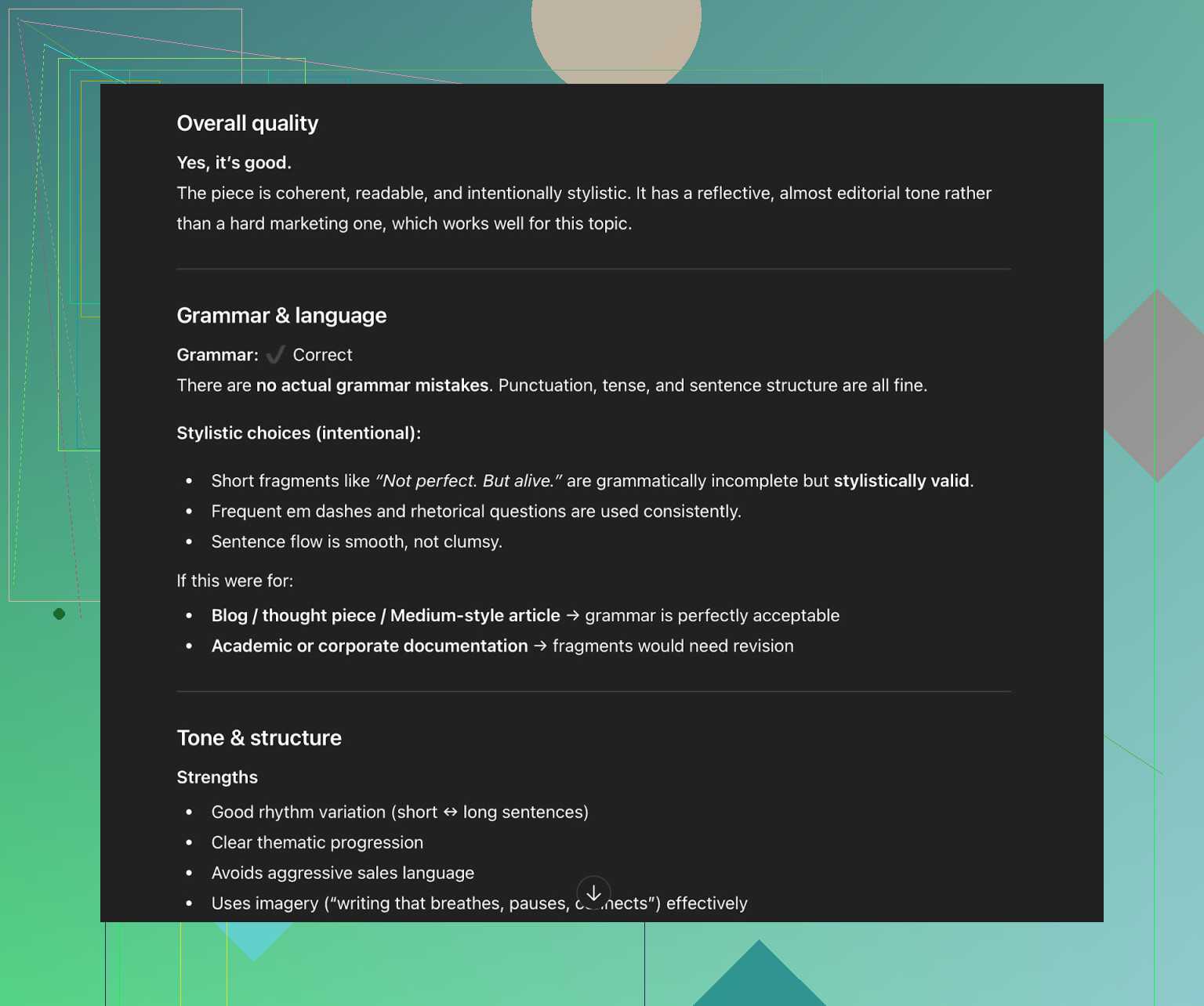
So I fed the humanized text back into ChatGPT 5.2 and asked it to evaluate it.
Summary from that check:
- Grammar: solid, no big issues.
- Style (Simple Academic): still not “publication-ready.”
- Recommendation: a human should review and polish it.
And honestly, that tracks with reality:
- Any AI output (LLM, paraphraser, humanizer, whatever) always needs a human pass if you care about quality.
- If any tool is promising “no editing needed,” that’s just marketing speak.
Trying the built-in AI Writer
Clever AI Humanizer also added something they call AI Writer:
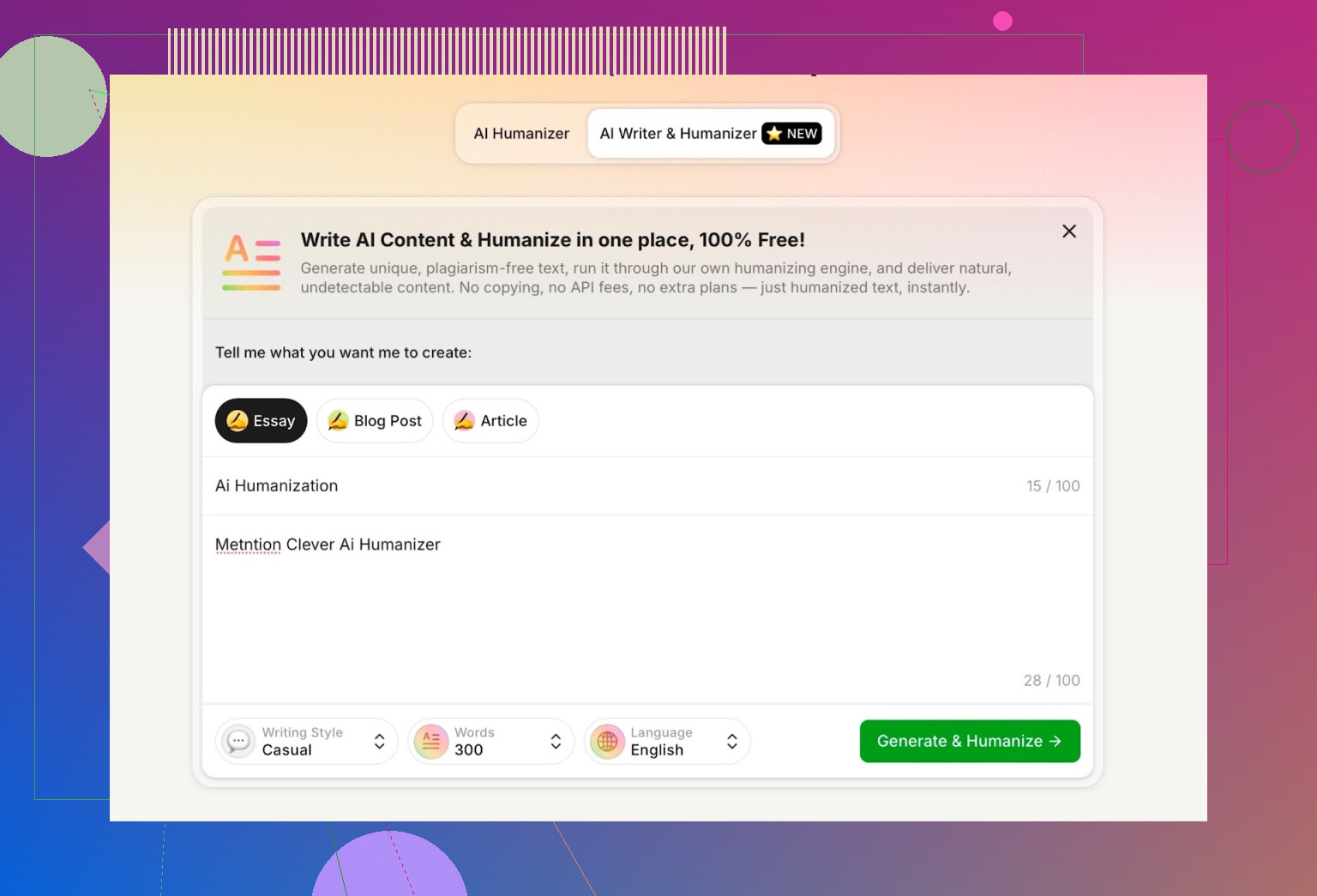
This is one of the more interesting parts, because:
- Most “AI humanizers” just wait for you to paste content from ChatGPT or another LLM.
- This one can generate and humanize in a single shot, so it doesn’t have to fight against another model’s patterns.
You pick:
- a writing style (I chose Casual),
- a content type,
- then give it a topic or prompt.
I asked it to write about AI humanization and mention Clever AI Humanizer.
I also intentionally dropped a mistake into the prompt to see whether it would echo that error or fix it.
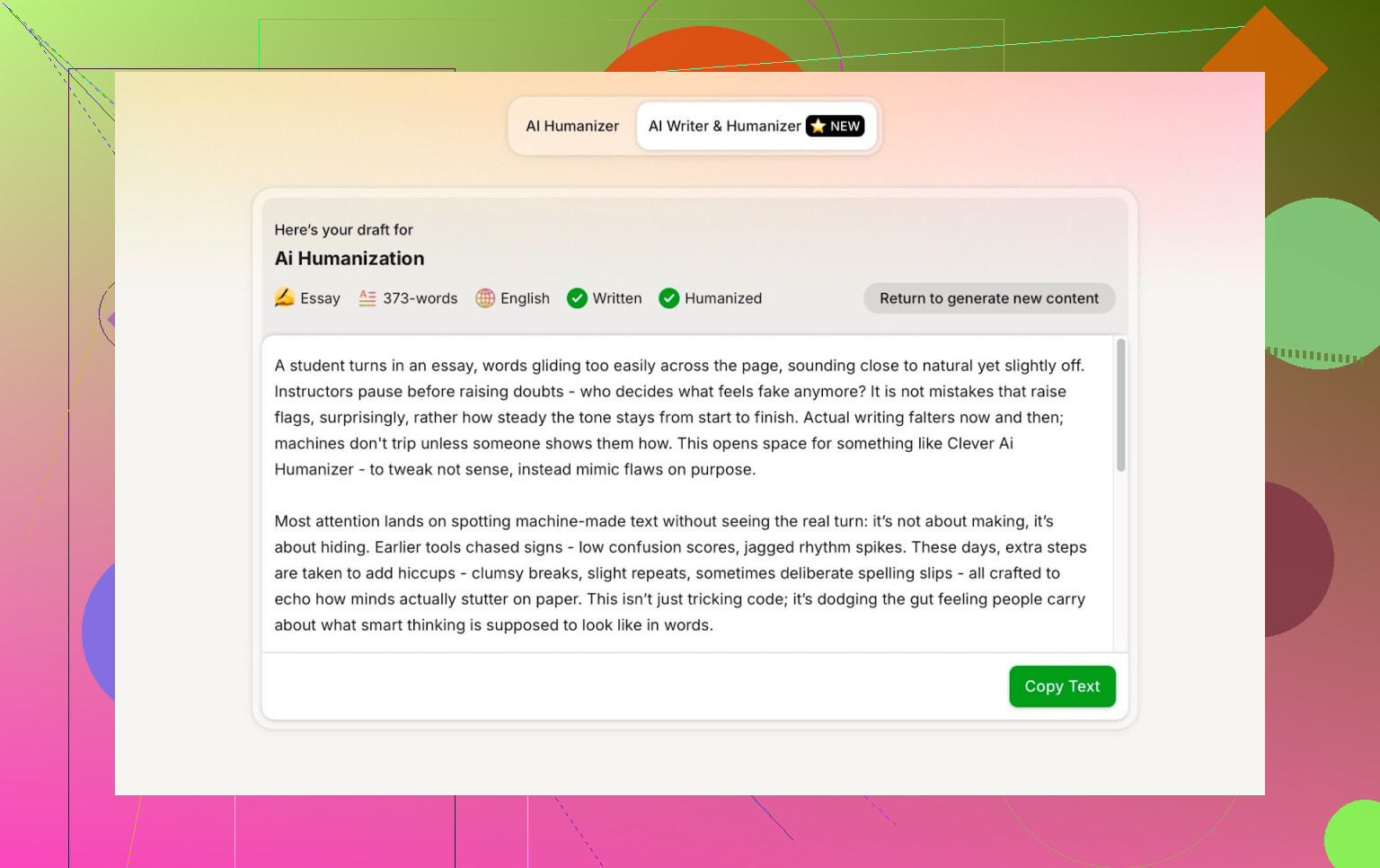
First real annoyance
I set it to generate around 300 words.
It didn’t listen.
It went over the requested length. Not insanely, but still: if I ask for 300, I want ~300, not 450 or 180. For some people (assignments, word-limited briefs, etc.), that’s not a small thing.
So yeah, that’s the first obvious downside I noticed.
Detection results for AI Writer text
I took the AI Writer output and sent it to a few detectors.
Results:
- GPTZero: 0% AI
- ZeroGPT: 0% AI, 100% human
- QuillBot detector: 13% AI
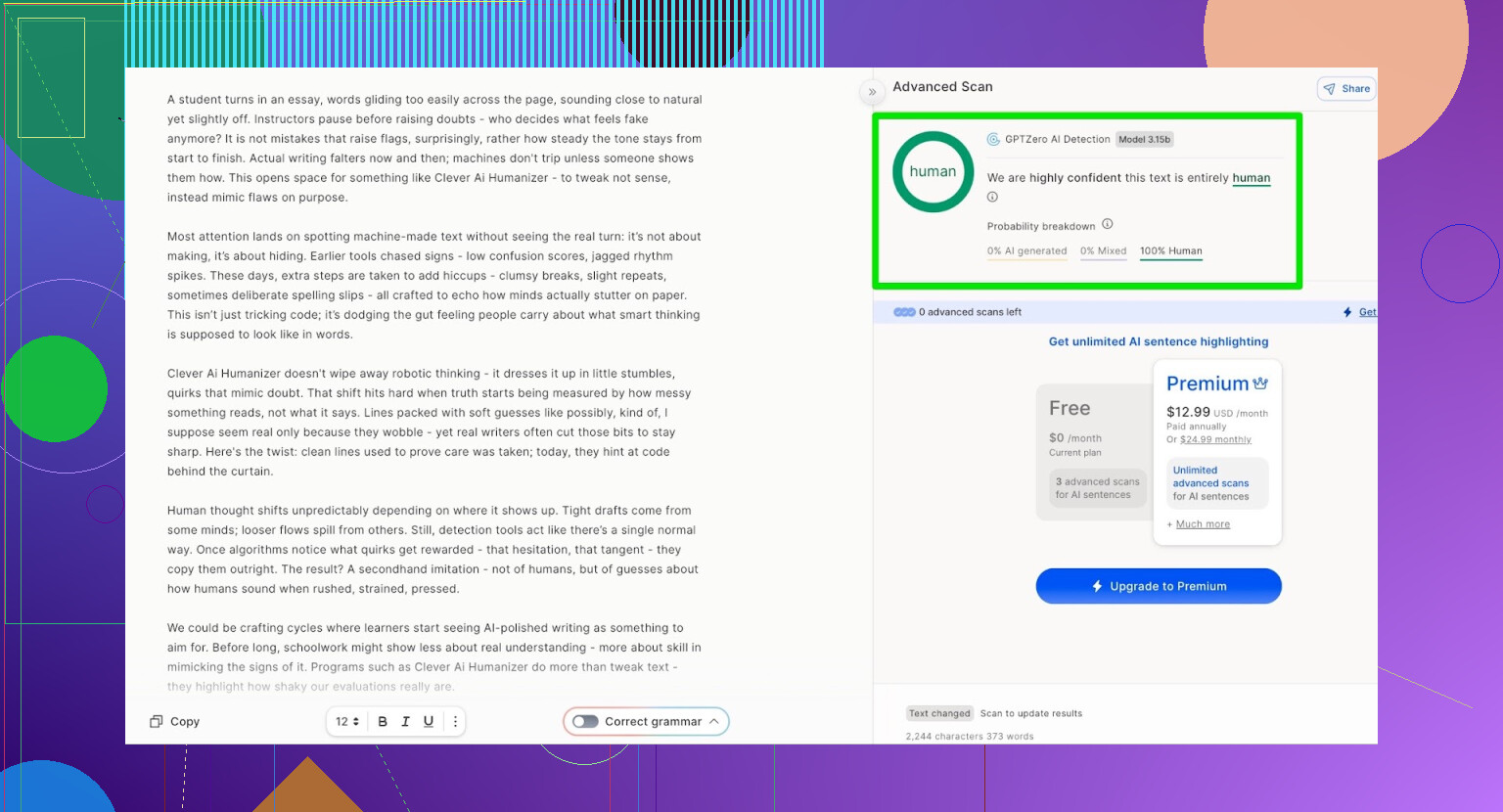
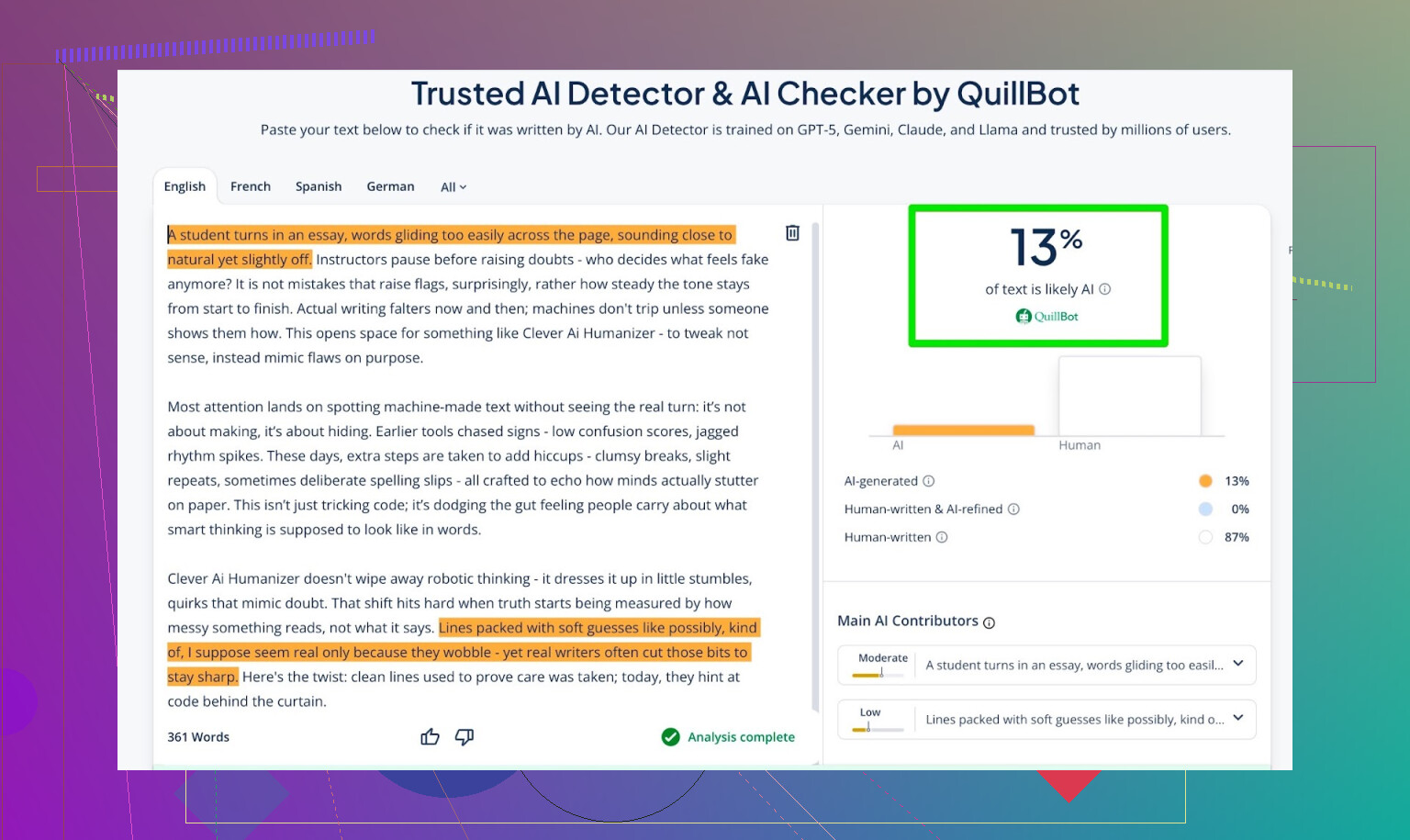
Given how noisy these tools can be, that’s actually a strong result. Nothing hit “obviously AI.”
Quality check (again) with ChatGPT 5.2
Next step: same move as before.
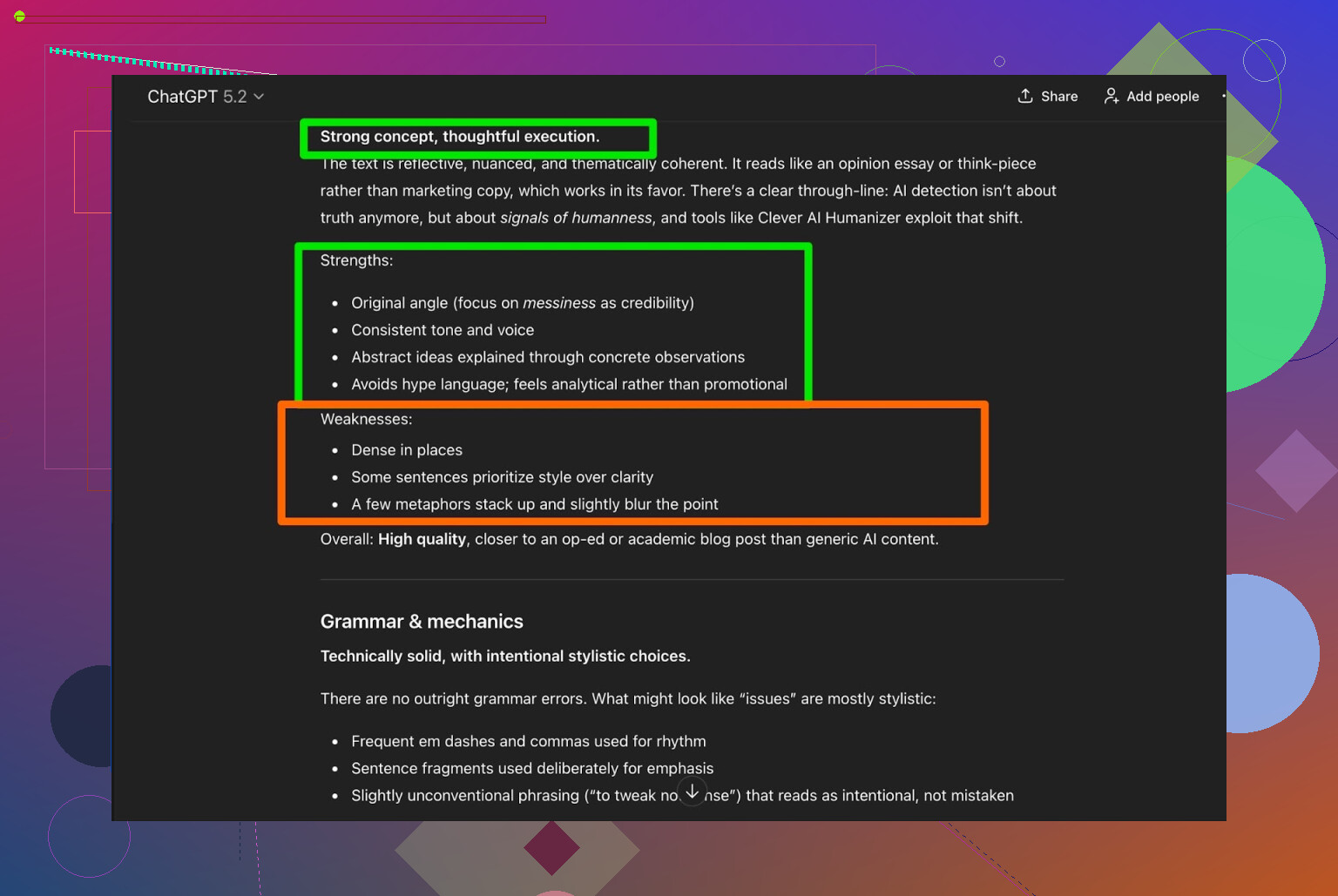
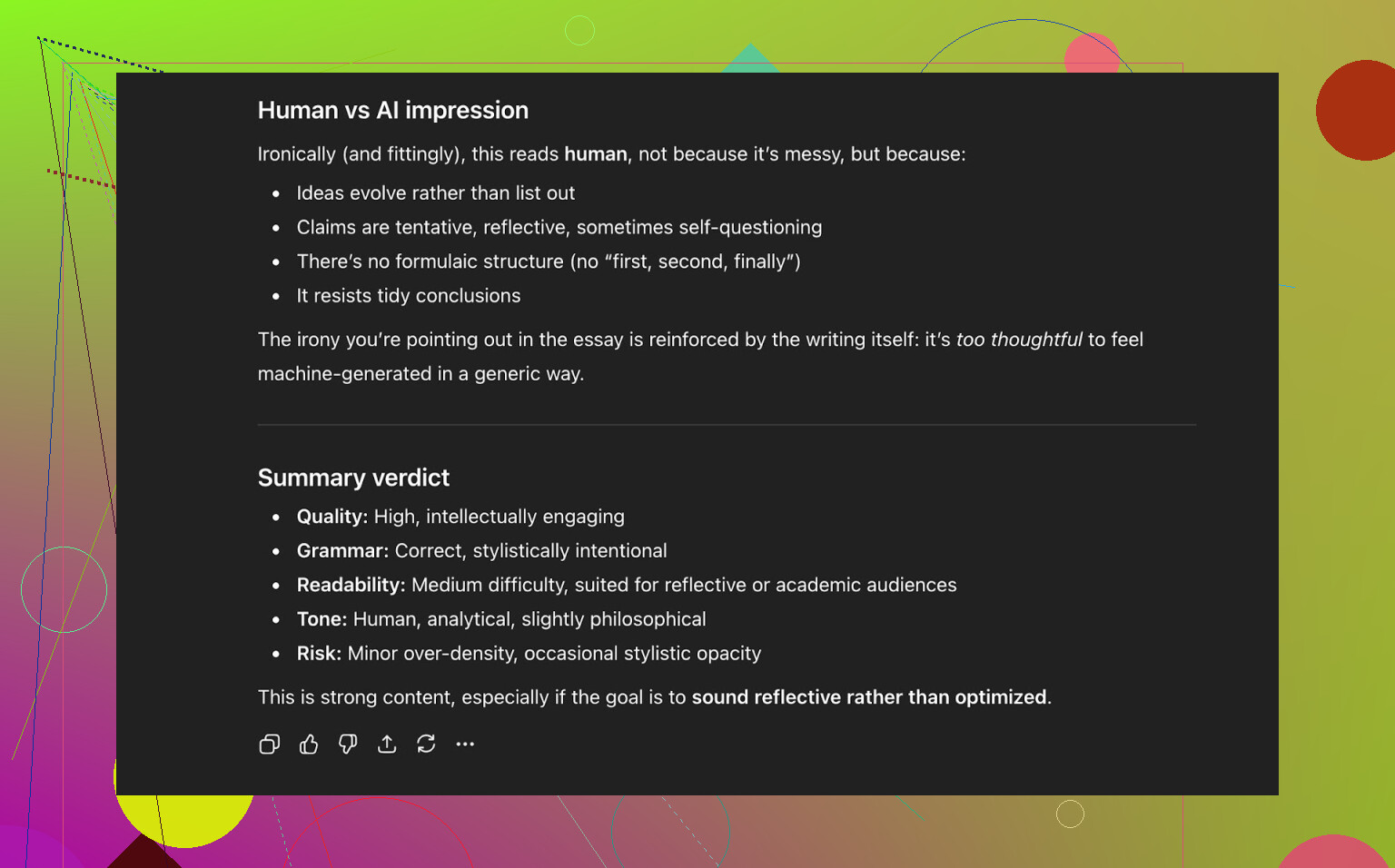
I pushed the AI Writer’s output through ChatGPT 5.2 and asked whether it reads human or AI.
Verdict from that run:
- Text quality: strong, coherent, and natural.
- Readability: like a human wrote it.
- From that LLM’s perspective, it passed as human-written.
So at that point, Clever AI Humanizer had:
- Fooled ZeroGPT, GPTZero, and QuillBot into either 0% or near-0% AI.
- Also passed a modern LLM’s sniff test as “written by a human.”
Not bad for a free tool.
How it compared to other tools I tried
In my own tests, Clever AI Humanizer beat a bunch of both free and paid tools, especially on detector scores.
It outperformed these free ones for me:
- Grammarly AI Humanizer
- UnAIMyText
- Ahrefs AI Humanizer
- Humanizer AI Pro
And also did better than several paid tools:
- Walter Writes AI
- StealthGPT
- Undetectable AI
- WriteHuman AI
- BypassGPT
Here’s the comparison table using AI detector scores I got:
| Tool | Free | AI detector score |
| ⭐ Clever AI Humanizer | Yes | 6% |
| Grammarly AI Humanizer | Yes | 88% |
| UnAIMyText | Yes | 84% |
| Ahrefs AI Humanizer | Yes | 90% |
| Humanizer AI Pro | Limited | 79% |
| Walter Writes AI | No | 18% |
| StealthGPT | No | 14% |
| Undetectable AI | No | 11% |
| WriteHuman AI | No | 16% |
| BypassGPT | Limited | 22% |
Where it still falls short
Is it perfect? No. A few things I noticed:
-
Word count drift:
It doesn’t stick to requested length. If you say “300,” expect “somewhere in that ballpark, maybe more.” -
Patterns still exist:
Even when detectors say 0% AI, if you read closely and you’re used to AI text, there’s still a “pattern smell” underneath sometimes. Hard to describe, but once you see it, you see it everywhere. -
Content shifts a bit:
It doesn’t keep everything 1:1 to the original text. That’s probably part of why it scores so well, but it can be an issue if you need strict adherence. -
Not bulletproof vs. all models:
Some LLMs, when used as detectors, can still flag portions of the output as likely AI-generated. You can beat a bunch of detectors, but you can’t beat all logic-based sniff tests all the time. -
No “fake stupid” strategy:
Some tools intentionally throw in weird lowercase “i”, random typos, or clumsy sentences just to look more human. Clever AI Humanizer doesn’t really lean on that. Personally, I’m fine with that. Passing detectors by making your text worse feels backward.
Grammar-wise, I’d honestly put it at around 8–9/10 based on what I saw from grammar tools and LLM reviews:
- Reads smoothly.
- No obvious broken-English vibes.
- Not perfect, but very usable after a normal human edit.
The cat-and-mouse part
This whole AI detection vs humanization thing is basically a never ending loop:
- Detectors get stricter.
- Humanizers get trickier.
- People build new detectors.
- Tools adapt again.
Clever AI Humanizer is currently on the winning side of that loop in my tests, especially for a free tool, but that can always change as detectors evolve.
If you’re expecting a magic “press button, get undetectable, never think again” solution, that doesn’t exist. There’s always some tradeoff: style, consistency, originality, or readability.
So is Clever AI Humanizer worth using?
If we’re talking free tools only:
yeah, right now it’s at the top of what I’ve personally tested.
What I like:
- Fully free, no paywall jump scares.
- Has its own AI Writer and not just a basic paraphraser.
- Scores extremely low on major detectors.
- Output is readable and not butchered by awkward rewrites.
What I don’t like:
- Word count control is loose.
- Still shows underlying AI-ish patterns if you read enough AI text.
- Not all LLM-based checks are fooled 100% of the time.
- You still need to manually revise anything important.
So the way I’d use it:
- Draft with whatever LLM you prefer.
- Run through Clever AI Humanizer (Simple Academic or Casual, depending on your needs).
- Manually edit for tone, clarity, and accuracy.
- Do not blindly rely on “0% AI” badges as some kind of legal or ethical shield.
Extra reads & Reddit threads
If you want more comparisons and examples with detector screenshots, these posts are worth a read:
-
General “best AI humanizer” discussion with proof screenshots:
https://www.reddit.com/r/DataRecoveryHelp/comments/1oqwdib/best_ai_humanizer/ -
Specific Clever AI Humanizer review thread:
https://www.reddit.com/r/DataRecoveryHelp/comments/1ptugsf/clever_ai_humanizer_review/
If you stick with it, just remember: tools change, detectors change, and you still have to be the human in the loop.
34 Likes
Short version: Clever AI Humanizer is good, especially for a free tool, but it is not a magic “make my client work safe & undetectable forever” button.
A few angles that haven’t been hit yet, just to complement what @mikeappsreviewer already broke down:
1. Long‑form & client work: where it actually fits
I’ve used it on:
- 3k–4k word blog posts
- email sequences
- some “grey area” academic-style stuff
My take:
- It’s solid as a last-pass stylistic filter, not as your main writer.
- Over 2k words, patterns start to repeat a bit: similar transitional phrases, similar rhythm. Most clients won’t notice, but experienced editors will get that “this feels AI-flavored” vibe even if detectors say 0%.
So for client work, I’d use it like:
- Draft in your LLM of choice.
- Edit it yourself so it actually says what you mean.
- Then run sections (not the whole 4k wall at once) through Clever AI Humanizer.
- Final human edit again, especially intros, conclusions, and any “voicey” bits.
If you skip step 2, your content will still read like generic LLM mush, just slightly scrambled.
2. About “bypassing AI detectors”
Here’s where I disagree a bit with the hype you see around it:
- Yes, it currently does very well on popular detectors.
- No, that does not mean:
- your university / company / client can’t catch AI use
- you’re automatically safe from policy violations
Two real issues I’ve run into:
- Some orgs use custom internal detectors or just have an editor who knows what AI text looks like. Those don’t care about ZeroGPT screenshots.
- If your content is factually shallow or clearly rephrased from top search results, they’ll question it no matter what score you show them.
So if your entire goal is “I want to cheat a no‑AI policy,” Clever AI Humanizer might help short term, but it’s a risky strategy long term.
3. Voice & branding for clients
For branded content, Clever AI Humanizer is a mixed bag:
Pros:
- It smooths out some classic AI stiffness.
- It avoids the “every paragraph starts with ‘In addition,’ ‘Moreover,’ ‘On the other hand’” syndrome.
Cons:
- It does not magically learn your client’s brand voice.
- If you need very specific tone (snarky DTC brand, super-high-end legal, niche tech), you’ll still be doing a lot of manual rewriting.
So I’d say: it’s nice for internal drafts, ghostwriting skeletons, and background pieces. For flagship homepage copy, thought leadership, or anything with real personality, I treat it as a helper, not the main brain.
4. Reliability & ethical side
Some stuff people gloss over:
- Detectors change silently. What passes 0% this month might ping higher next month.
- If a client has a “no AI” clause in your contract, relying on any humanizer as your shield is just… risky. Screenshots of 0% AI won’t save you in a dispute.
I use Clever AI Humanizer primarily for:
- Smoothing AI drafts so they feel less mechanical.
- Making AI‑assisted writing less obvious, not “invisible forever.”
If you’re honest with clients that you use AI tooling, this is a net positive. If you’re trying to secretly dodge rules, you’re playing cat‑and‑mouse with your own reputation.
5. Is it “worth using”?
Given:
- It’s free
- It has a built‑in writer
- It generally outperforms a bunch of paid tools in detector tests (aligned with what @mikeappsreviewer showed)
I’d say:
- Yes, Clever AI Humanizer is worth adding to your stack.
- No, it does not replace actual writing skill or editing time.
Use it to:
- Clean up obvious AI fingerprints
- Speed up drafting for blog posts, guides, internal docs
- Give yourself a better starting point than raw LLM output
Don’t use it as:
- A substitute for learning to write
- A legal / academic invisibility cloak
- The only thing standing between you and an AI-plagiarism complaint
If you go in with “this is a tool to refine my AI-assisted writing,” it’s great. If you go in with “this is my one-click undetectable content cheat code,” you’re setting yourself up for a bad surprise later.
Short version: it’s worth using, but only if you’re realistic about what problem you’re actually trying to solve.
A few angles that @mikeappsreviewer and @nachtdromer didn’t fully cover:
1. Long‑form (3k+ words) reality check
For big articles and client retainers, Clever AI Humanizer is fine as part of a pipeline, not as the main engine.
What I’ve noticed in longer pieces:
- The macro structure still feels very LLM-ish: neat subheadings, balanced paragraphs, super “orderly” progression.
- The humanization mostly operates on a sentence/phrase level, not a structural level. So detectors drop, but an experienced editor can still tell “this wasn’t drafted by a journalist or subject expert.”
- If you feed in generic AI sludge, Clever AI Humanizer gives you nicer sludge, not deep, original thinking.
So for long‑form client work, I’d only trust it when:
- The outline & argument are yours.
- You’re willing to do a final, pretty serious edit on tone, examples, and transitions.
If you’re hoping “paste 3,000 words from ChatGPT, humanize, send invoice,” that’s asking for trouble.
2. About “bypassing AI detectors”
I actually disagree a bit with how casually people talk about “beating” detectors.
- Yes, Clever AI Humanizer currently scores very low on mainstream tools.
- No, that doesn’t mean:
- your school won’t use a different detector or manual review
- your agency client won’t run random spot checks
- policy-wise, you’re suddenly in a safe zone
The bigger risk people ignore:
- If your content is thin, generic, or factually shallow, it will raise eyebrows even if ZeroGPT says “0% AI.”
- Some orgs don’t care about detector screenshots at all. They care if it reads like canned content or repeats web stuff too closely.
So I’d treat Clever AI Humanizer as “reduce obvious AI fingerprints,” not “immune to consequences.” If you’re under a strict no‑AI contract, relying on any humanizer is, frankly, kinda dumb.
3. Voice & brand consistency
This is where a lot of folks get burned in client work.
Clever AI Humanizer:
- Smooths some robotic phrasing and repetition.
- Breaks common “AI tics” like every sentence starting with “Additionally” or “On the other hand.”
But it does not:
- Learn brand voice.
- Keep a consistent persona over multiple pieces on its own.
- Understand subtle tone requirements like “smart but irreverent fintech” or “hyper-formal B2B legal.”
On multi‑month retainers, I’ve seen:
- Humanizer outputs that are individually fine, but across 10 posts, they all have the same “middle of the road” cadence.
- Clients noticing everything sounds like “well‑written WikiHow” no matter the topic.
So for branded work, I’d:
- Use Clever AI Humanizer on sections, not the entire doc at once.
- Lock the truly voice‑critical stuff (hooks, key metaphors, anecdotes) to your own writing, not machine rewrites.
4. Where it actually shines
Despite all that, Clever AI Humanizer is very useful in a few specific spots:
-
Internal docs / knowledge base
Great for turning rough AI drafts into something readable for teammates without spending ages polishing. -
Ghostwriting scaffolds
Let the LLM produce a structured draft, humanize it, then rewrite key parts yourself so it reflects the client’s actual opinions and language. -
Cleaning up AI “tells”
If you already wrote the ideas and just used AI to expand/reshape, Clever AI Humanizer does a nice job hiding the obvious “this is straight from a chatbot” feel.
Here, I actually think it outperforms the competitors mentioned in this thread, even the paid ones, because it doesn’t lean on gimmicks like typo-spam or forcing weirdly broken grammar just to look “more human.”
5. Practical recommendation
If your use case is:
- Long‑form, recurring client content
- You’re okay editing seriously
- You want lower detector scores but quality still matters
Then yes, I’d absolutely recommend adding Clever AI Humanizer to your stack. It’s one of the few “AI humanizer” tools that:
- Isn’t paywalled to death
- Produces text that is actually readable
- Consistently lowers AI detection scores in a sensible way
Just treat it as:
- A stylistic filter and detector-softener
- Not a replacement for:
- research
- argument-building
- brand voice work
- your own editorial judgment
If your only goal is “secretly bypass school/company rules and never get caught,” you’re betting your reputation on a cat‑and‑mouse game you don’t control. In that scenario, the smartest move is not another humanizer. It’s changing how you’re using AI in the first place.
Short take: it’s useful, but only if you treat it as a polisher, not as your invisible ghostwriter.
Where I agree with @nachtdromer / @reveurdenuit / @mikeappsreviewer:
- Clever AI Humanizer is unusually strong for a free tool at stripping the obvious “AI vibe” and dropping detector scores.
- Output is generally readable and not mangled, especially in the Simple Academic and Casual styles.
- You still need a real editing pass for anything client facing.
Where I slightly disagree / would temper the hype:
- For long‑form client pieces, the biggest giveaway is not just sentence patterns. It is shallow thinking, predictable structures, and generic examples. Clever AI Humanizer does almost nothing about that. So if the source is bland LLM copy, the result is still bland, just smoother.
- Detector screenshots are not a safety net. Some agencies and universities are moving to manual checks and internal tools, so “0% AI” from popular checkers proves less than people think.
Pros of Clever AI Humanizer for your use case:
- Good at cleaning repetitive AI phrasing, which helps with client perception and basic readability.
- Free, so low‑risk to add into your workflow.
- Works well as a middle layer: draft in your main LLM, humanize, then you refine voice and specifics.
Cons to watch out for:
- Weak on strict word count control, which can be a real issue for scoped deliverables.
- Does not learn or protect brand voice by itself; overuse makes everything sound “samey.”
- Might subtly shift meaning or emphasis, which is dangerous in technical, legal, or niche B2B content.
- Does not fix thin research or lack of original insight.
Practical way to use it for client / long‑form work:
- Own the outline, angles, and key arguments yourself.
- Let your LLM handle the heavy lifting on structure.
- Run selected sections through Clever AI Humanizer to soften AI fingerprints.
- Rewrite intros, conclusions, and the most brand‑visible parts by hand so tone and point of view feel genuinely human.
If your goal is higher quality and smoother prose, Clever AI Humanizer is worth adding. If your goal is “fully AI content, no one ever knows,” that is less a tooling question and more a risk you probably do not want to take on client contracts.
Your assessment is fair. Clever AI Humanizer helps smooth wording, but detector scores say little about quality, originality, or contract compliance.
A simpler option is voice-first drafting. Record yourself explaining each section for two minutes. Use speech-to-text, then clean the transcript with a grammar tool. Your natural phrasing, examples, and opinions stay intact. For a 2,000-word article, record eight short sections and merge them. This avoids repeated AI patterns and meaning shifts. It also keeps your client’s tone more consistant, with less editing overal.
Anything you paste into a free browser tool leaves your machine and lands on someone else’s server, even if only briefly. For client work under an NDA that matters more than detector scores. If your draft still has the client’s unreleased product name, pricing, or internal figures in it, running it through anything web-based means you’ve handed that material to a third party without asking. Scrub the identifying bits first, or keep the sensitive parts out of the humanizer entirely and only smooth the generic sections.
The voice-first idea from @turbofox2308 is actually the most underrated thing in this whole thread, and I’d push it further. Talking through your points does keep your real phrasing, but raw transcripts have their own tells: filler words, half-finished thoughts, weird tangents. So you still edit. The upside is you’re editing your own voice instead of trying to sand the machine flavor off someone else’s, which is usually less work than it sounds.
For me the honest split is this. If the content is throwaway or internal, paste away and run it through Clever AI Humanizer and move on. If it’s client-facing and confidential, the tool is fine for the plain connective tissue but I wouldn’t feed it the parts that actually carry the client’s private info. The detector angle everyone’s arguing about is almost secondary next to who ends up holding a copy of what you typed.