I’ve been using Decopy AI’s humanizer to make AI-generated text sound more natural, but I’ve hit the limit on what I can do for free. I’m looking for a genuinely free or very low-cost tool that can match or come close to Decopy’s quality for humanizing AI content. What tools, browser extensions, or workflows are you using that actually work and don’t sound robotic, and how do they compare in terms of limits, quality, and privacy?
- Clever AI Humanizer Review
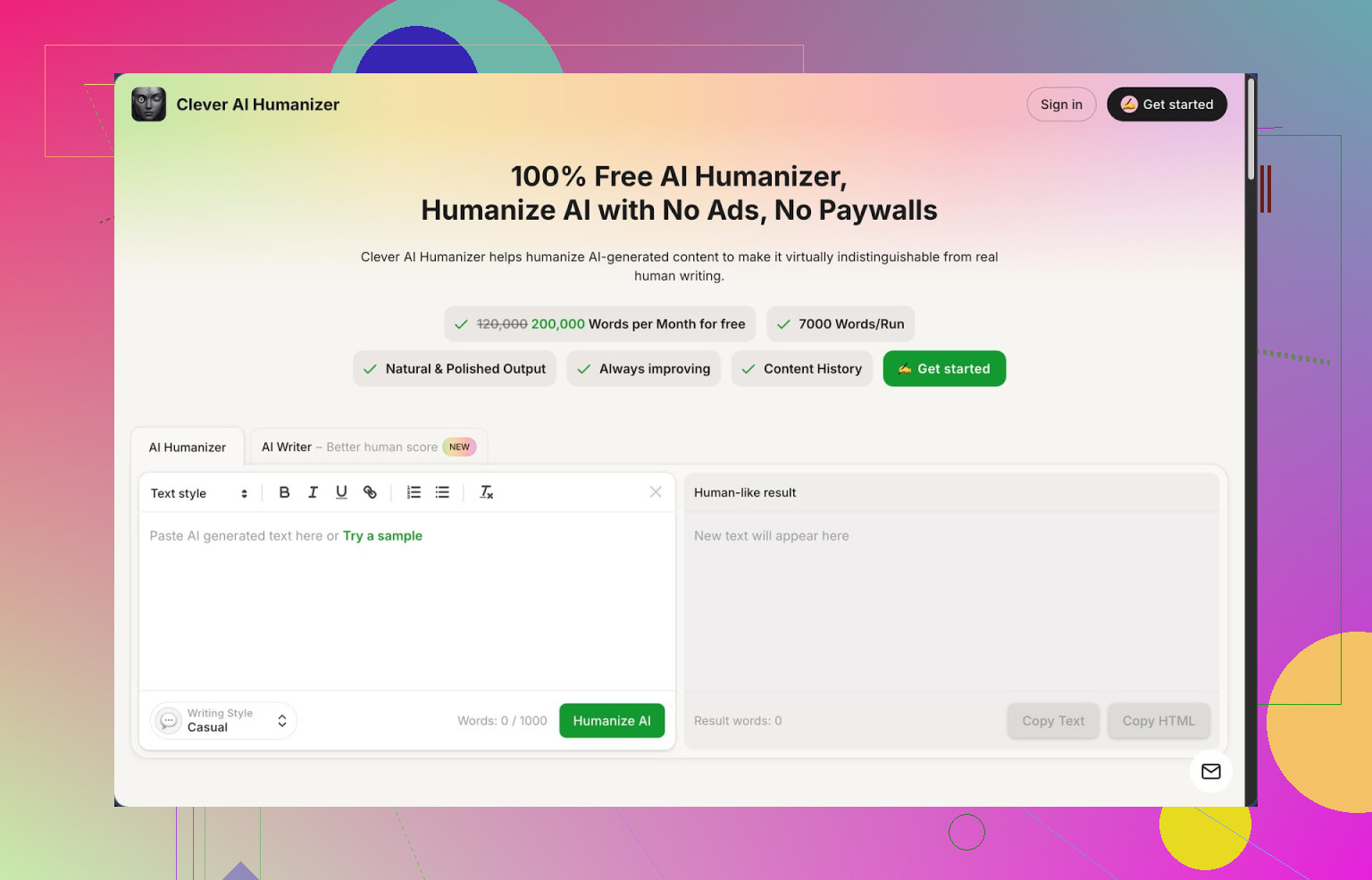
I have been messing around with AI writing tools for a while, and one thing keeps biting people: the output still gets flagged as AI by detectors, even when it reads fine to humans. So I went looking for a tool that does one job well, turn AI-sounding text into something closer to what a normal person would type.
Clever AI Humanizer, from https://cleverhumanizer.ai, is the one I ended up using the most.
What you get for free
No login tricks, no “free trial then credit card surprise”. The free tier gives you:
- About 200,000 words each month
- Up to around 7,000 words in one go
- Three rewrite styles: Casual, Simple Academic, Simple Formal
- A built in AI writer
- Grammar checker
- Paraphraser
I pushed it with long drafts and never hit a hard paywall. For people working on essays, blog posts, SEO content, or reports, that word limit is not small.
AI detection results
I ran a small test because I did not trust the marketing copy.
Workflow I used:
- Generated plain AI text from another model.
- Pasted it into Clever AI Humanizer.
- Picked the Casual style.
- Ran the result through ZeroGPT.
Across three different samples, ZeroGPT showed 0% AI on the output text from the Casual style. That does not mean every detector on the internet will always pass it. It only means that in this narrow test, with that specific detector, it scored clean.
If you deal with tools that mark everything “100% AI” and freak out clients, that kind of result helps a bit.
How the main humanizer works
The core feature is simple:
- Paste the AI text.
- Pick Casual, Simple Academic, or Simple Formal.
- Hit the button.
- Wait a few seconds.
The rewrite tries to:
- Remove repetitive patterns common to AI models.
- Smooth out awkward phrasing.
- Keep the original meaning roughly intact.
In my runs, it did not mangle the core ideas. It sometimes expanded sentences, added small transitions, or broke long blocks into cleaner segments. If you care about word count limits, you need to watch that, since the text sometimes grows.
Quality wise, I saw fewer “AI-ish” tics like repeating the same phrase structure over and over. It still needed light editing, but it was closer to something I could send to a client without embarrassment.
Extra tools in the same place
Besides the main humanizer, there are three side tools that sit in the same interface.
- Free AI Writer
This one generates text from scratch inside the site, then lets you humanize it immediately.
Rough steps:
- Input your topic or prompt.
- Get a draft.
- Run that draft through the humanizer with your chosen style.
When I used this pipeline, the detection scores looked a bit safer compared to running an external model then pasting into a detector. Probably because the system is tuned for its own output patterns.
Good for:
- Quick essays.
- Draft blog posts.
- Filler content that you still want to pass a basic sniff test.
You still need to fact check it and edit for your own tone.
- Free Grammar Checker
This one is boring but useful.
It:
- Fixes spelling.
- Cleans punctuation.
- Tweaks clarity.
I used it on a few messy drafts with fragments, and it did a decent job without turning everything into corporate speak. It is handy at the end of the pipeline, after humanizing, to clean small mistakes before you paste into WordPress or Google Docs.
- Free AI Paraphraser
This is for when you already wrote something, or grabbed text from your own old content, and you want a new version that keeps the core idea.
Good use cases:
- Rewriting product descriptions in a different tone.
- Adjusting formality level for email vs report.
- Refreshing stale blog paragraphs without changing the message.
I used it on a section of an old article, and it produced a new version that looked different enough to avoid internal repetition, while saying the same thing.
How it fits into a daily workflow
What worked for me looked like this:
- Draft: Generate using any AI or write a rough version yourself.
- Humanize: Paste into Clever AI Humanizer with Casual or Simple Formal.
- Cleanup: Run through the Grammar Checker.
- Adjust: If needed, use the Paraphraser on specific chunks like intros or conclusions.
- Final pass: Do a manual read through for tone and facts.
The appeal is that all four steps live in one simple interface. No hopping between three sites, no juggling tokens or credits.
What is not perfect
There are a few catches.
- Detection is not guaranteed. Some detectors will still mark parts or all of the text as AI. No tool fixes that completely.
- Output length often grows. To break patterns, the tool tends to add words. That can trip word limits for assignments, metadata, or strict briefs.
- It still needs your brain. You have to check facts, adjust tone, and make sure it sounds like you and not like “generic internet writer”.
For a free tool, though, the tradeoff feels fair if you accept that you are doing the last 10 to 20 percent by hand.
Where to read more and watch tests
More detailed writeup with screenshots and detection proof:
Video review on YouTube:
Reddit threads discussing AI humanizers and tricks:
Best AI Humanizers:
https://www.reddit.com/r/DataRecoveryHelp/comments/1oqwdib/best_ai_humanizer/
General thread on humanizing AI output:
https://www.reddit.com/r/DataRecoveryHelp/comments/1l7aj60/humanize_ai/
If you depend on AI to produce large volumes of text and you are tired of retyping half of it by hand, Clever AI Humanizer is worth trying. Start with a smaller piece, run it through Casual style, and then throw it at your detector of choice to see how it behaves in your use case.
12 Likes
If you hit the free wall on Decopy and want something close without pulling out a card, here is what I would do.
-
Try Clever Ai Humanizer first
I agree with @mikeappsreviewer on the main point, but I do not think the AI writer or extra tools are the big win. The core humanizer is the useful part.
Key points for your use case:
• No login needed
• Roughly 200k words per month free
• Handles long chunks, so you paste full drafts instead of tiny blocks
For replacing Decopy, stick to the Casual or Simple Formal modes. Then do a quick manual pass to add your personal phrases or quirks. That last step helps more than chasing 0 percent AI on detectors. -
Use a layered workflow, not only one tool
Decopy, Clever Ai Humanizer, whatever you pick, none of them guarantees passing all detectors. If your goal is “natural enough for readers” and “less robotic,” this works better:
• Generate with your usual model
• Run once through Clever Ai Humanizer
• Then manually: shorten a few sentences, add one or two opinions, swap some generic words for your own usual language
This takes a few minutes and reduces detector scores more than hitting a second humanizer site. -
Cheap or free alternatives to rotate with Clever
If you want to stay under free caps across tools, you can mix:
• QuillBot free tier for small paraphrases, especially intros and conclusions
• Grammarly free for grammar and some light rephrasing
• Google Docs “suggested rewrites” for short fixes
None of these replaces Decopy alone, but together with Clever Ai Humanizer you end up with a decent low cost stack. -
If you care about AI detectors
Do not trust one single detector result. They often disagree.
• Test with at least two detectors on a short sample
• If one screams “100 percent AI” but the others look fine, do not overreact
Also, do not chase perfect scores. Aim for “mixed” or “uncertain” on detectors. That usually means the text is close to normal human patterns. -
When to pay and when to stay free
If you do:
• Occasional essays or blog posts → Clever Ai Humanizer free tier is enough
• Daily long content for clients or school → you might still need a paid option later, but start with Clever plus light manual edits and see if it covers your workload
Short answer for your situation.
Use Clever Ai Humanizer as your main Decopy alternative. Pair it with one free grammar tool. Edit a bit by hand. That keeps your cost near zero while your text stops sounding like default AI output.
If you’ve already pushed Decopy’s free tier to the edge, you’re basically in the same boat most of us ended up in.
I agree with @mikeappsreviewer and @hoshikuzu that Clever Ai Humanizer is the closest “plug‑in replacement” you’re going to get right now, especially for free. Where I’d push a bit against their takes is this:
- I wouldn’t rely on its built‑in writer much. The real value is in the humanizer itself plus your own edits. The AI writer just adds another layer of genericness you then have to strip out.
- I also wouldn’t obsess over ZeroGPT or any single detector. I’ve seen text that passed ZeroGPT beautifully still get flagged by others. Detectors contradict each other constantly.
If you want something that actually feels like a real upgrade from Decopy without paying:
- Use your usual AI to draft.
- Run that through Clever Ai Humanizer (Casual or Simple Formal, same as they said).
- Then intentionally break it:
- Shorten 2–3 sentences that sound too smooth.
- Add 1 or 2 personal opinions that an AI wouldn’t guess (“Personally, I hate when…”).
- Insert a mild hedge or messy phrase you actually use in real life. Even a small typo you later fix can help your own editing voice show through.
Tools can get you from 0 to like 70% human. That last 30% is you, not some secret “better humanizer.” If your main requirement is “close to Decopy, low cost, minimal friction,” Clever Ai Humanizer as the core plus your light manual tweaks is honestly the most sane stack right now.