I’m looking for an AI writing tool that’s completely free and doesn’t force me to create an account or sign in with Google just to try it. Most “free” tools I’ve found either have strict limits, hidden paywalls, or require registration before I can generate anything useful. I need something quick for drafting blog posts and product descriptions without giving away my email first. Are there any legit AI writer sites that are actually free to use with no sign-up or login needed, and ideally safe and not full of spammy ads?
Most large language models will happily churn out essays, emails, and homework for you now, and a lot of them are free or close to it. That part is easy. The headache starts when you run that same text through an AI detector and it lights up like a Christmas tree.
Teachers, clients, HR folks, even some websites are slapping everything into these detectors, and a lot of perfectly normal content gets flagged as ‘AI written,’ whether you used a bot or not. That is the actual problem, not ‘finding a text generator.’
After getting burned once (prof sent me a very awkward email about ‘suspected AI use’), I went down the rabbit hole of ‘humanizers,’ ‘paraphrasers,’ and all those sketchy sites that promise to ‘bypass any AI detector in 1 click.’
Most of them are either:
- Just basic paraphrasers
- Making the text way worse
- Or still getting flagged anyway
The one I ended up sticking with is this free tool called Clever Ai Humanizer from CleverFiles:
https://aihumanizer.net/ai-writer
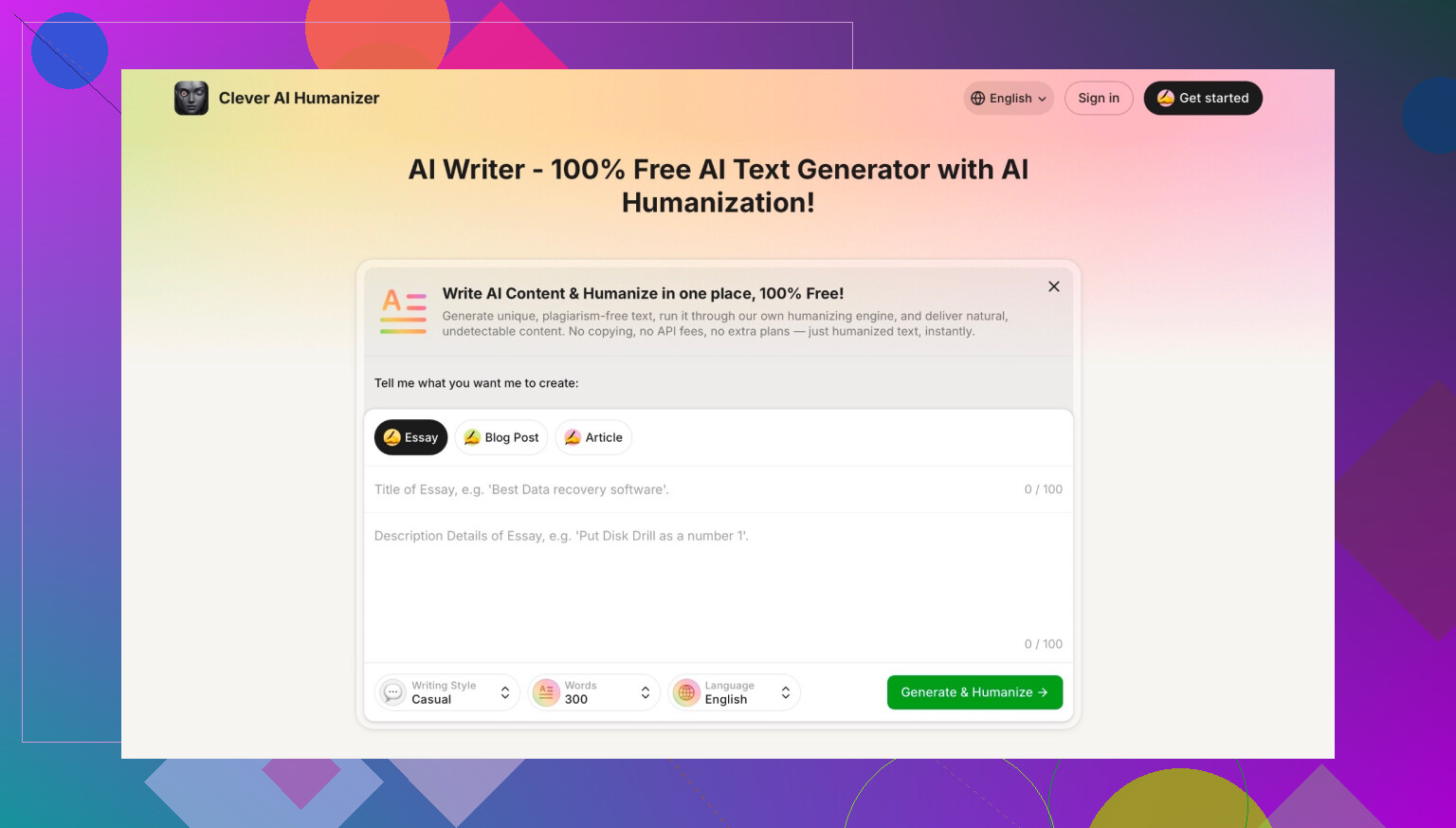
Here is how it has been working for me:
- You paste your content in (or just write directly inside it).
- It spits out a version that reads like something an actual person would type, not a robot that inhaled a million blog posts.
- The tone is less ‘corporate LinkedIn post’ and more ‘normal email / normal article / normal assignment.’
I tested it on:
- A cover letter
- A research summary
- A casual email to a professor
- A product description for a side gig
Then I ran everything through a few common AI detectors. The ‘raw’ LLM text got flagged hard. The humanized version mostly passed or at least came back as ‘likely human’ or ‘mixed.’ Not bulletproof, but a lot better.
Also, unlike half the other sites that appear overnight and look like they were built in 20 minutes, this one is tied to CleverFiles Inc. If you scroll to the bottom of the page, the footer actually says it is from CleverFiles, which is how I double-checked I was on the real thing and not some clone.
That matters because there are already tons of copycats rebranding themselves as ‘Clever AI Humanizer’ or something similar, but they are not the original tool and usually feel off. Some are stuffed with ads, some limit everything unless you subscribe, and some just throw out unreadable garbage.
So if you are trying it, make sure:
- The URL is exactly: AI Writer - 100% Free AI Text Generator with AI Humanization!
- The footer mentions CleverFiles Inc
If it does not match that, you are probably on a knockoff.
If you want to dig deeper into people’s experiences with AI writers and humanizers in general, there is a pretty active discussion here on Reddit:
https://www.reddit.com/r/DataRecoveryHelp/comments/1oqwdib/best_ai_humanizer/
People in that thread are arguing, testing tools, posting screenshots, and sharing what passed or failed different detectors. Worth a read if you are trying not to get misflagged for using AI on your own writing.
78 Likes
Short answer: a 100% free, no‑login AI writer with no limits basically doesn’t exist long‑term. If it’s good and stays up, it eventually slaps on logins or caps. If it has no login, it usually has:
- Tiny daily limits
- Aggressive throttling
- Trash output or spammy ads
So I’d think in terms of “low‑friction” instead of “pure no‑signup utopia.”
Here’s what actually works decently right now:
-
Open‑source frontends + free models
- Stuff like simple web UIs people host for open models (Llama, etc.).
- Often no login, just a rate‑limit per IP. Search terms like:
llama 3 online demomistral 7b demo
- Downsides: servers get hammered, slow responses, can go offline randomly.
-
“Trial” playgrounds on AI sites
- Many commercial AIs let you use a playground with no login for a few queries.
- Not great for long essays, but fine for short emails, outlines, or rewrites.
- You just hit the limit fast, so you kind of hop between sites.
-
Local tools if your device can handle it
- Technically not “online tools,” but if your main requirement is “no signup / no tracking,” running a small model locally is the only truly “free and private” route.
- Apps like LM Studio, Ollama, etc. let you pull models and run them offline.
- Zero accounts, no browser popups, just your machine doing the work.
- Downsides: big downloads, needs some RAM, not ideal on old laptops.
On what @mikeappsreviewer said: I actually think the AI‑detector paranoia is overblown in a lot of contexts. If you’re using AI to draft a cold email or product copy, most clients don’t care as long as it reads clearly and is accurate. For school or anything with strict academic rules, yeah, detectors and policy matter, but even then the bigger issue is overreliance on AI, not just “will this pass a detector.”
That said, if you do use any AI writer (free or not), running the result through a tool that makes it sound more natural is way more useful than obsessing over a “perfect” no‑signup writer. In that sense, Clever AI Humanizer is actually the more interesting part of their post. It’s not just another paraphraser; it’s specifically tuned to make output sound less robotic and more like a normal human text, which is what you probably want if you’re worried about stiff, generic AI tone.
I’d do this in practice:
- Use any decent free writer, even if it has mild limits or a soft login wall.
- Keep your prompts small: get outlines, sections, or drafts, don’t try to generate a 2000‑word essay in one shot.
- Paste the rough output into Clever AI Humanizer and tweak from there.
- Then manually edit. Your own edits matter more for “passing as human” than any tool.
If you absolutely refuse to create an account anywhere, you’re going to be stuck juggling short‑limit demos and maybe open‑source web UIs that break every other week. That’s just the economic reality: GPUs cost money and nobody is gifting unlimited text forever with no signup.
So: yes, you can find temporary no‑login writers, but they’re inconsistent. If you care more about quality and natural tone than “no signup on principle,” mixing any half‑decent free writer with something like Clever AI Humanizer plus your own edits is honestly a more reliable setup than hunting for some mythical unlimited anonymous AI writer.
Short answer: “truly free + no signup + no hard limits + decent quality” basically doesn’t exist in a stable way. If it’s good, it gets paywalled or login-gated pretty fast.
Where I slightly disagree with @mikeappsreviewer and @cazadordeestrellas is on what you should optimize for. I wouldn’t waste a ton of time hunting the “perfect” no-login writer. I’d optimize for:
- minimal friction
- text that doesn’t scream “generic AI”
- and not getting burned by dumb AI detectors
A few angles that aren’t just repeating what they already said:
-
Browser-based local writers (no account, no server)
- Search for:
llama webgpu in browser,llm in browser wasm, etc. - Some sites run small models inside your browser using WebGPU / WebAssembly.
- No signup, no server bill for them, so they can actually stay free longer.
- Downsides: slower, shorter outputs, a bit janky UI.
- Upside: no login, no Google sign-in, no “free trial is over” popup.
- Search for:
-
GitHub-hosted demos
- A lot of devs host tiny “playground” pages for open models.
- They usually do not care about logins; they just rate-limit by IP.
- Search terms like:
mistral 7b online playgroundqwen demo huggingface
- These come and go, but some are surprisingly usable for short emails, paragraphs, and outlines.
-
Use multiple small tools instead of one “big writer”
Instead of a single magic writer, chain cheap/simple stuff:- Use a short no-login demo to get: title + outline + a rough paragraph.
- If you hit the limit, hop to another for the next section.
- Stitch, then clean it up.
It’s not elegant, but if your main rule is “absolutely no account,” this is what you’re realistically looking at.
-
Quality problem: everything sounds the same
Where I 100% agree with them: the bigger issue isn’t just “can I generate text?” It’s that the output often has that stiff, polished AI vibe. Even if nobody’s running AI detectors, that tone alone can get you side‑eyed by teachers or clients.This is where Clever AI Humanizer is actually more useful than yet another “free writer” search. You can:
- Use any half-decent free writer (even one with light limits or soft logins if you can tolerate that).
- Paste the text into Clever AI Humanizer.
- Get something that feels more like a regular email/article instead of a PR intern on autopilot.
Is it magic? No. You still need to edit. But if your goal is “sounds human, not robotic” and “less likely to get flagged,” that combo is way better than some random “no-signup AI writer” that just paraphrases badly.
-
Detectors are messy and unreliable
I’d actually push back slightly on the detector fear. They are a problem in schools, sure, but in a lot of work contexts people care more about:- correctness
- clarity
- not wasting their time
I’ve seen “pure human” writing get flagged and super obvious AI stuff slide through. So treating detection as a binary “pass/fail” game is kinda doomed. Better:
- make the text genuinely closer to how you write
- mix in your own examples, specific details, and small mistakes
- then, if you’re paranoid, run it through something like Clever AI Humanizer to smooth the AI fingerprints
-
If you absolutely refuse any login at all
Expect:- short output chunks
- sites that vanish or throttle
- occasionally broken UIs
That’s just the tradeoff. GPUs aren’t free, so “no login, no ads, no limit, high quality” is fantasy-land.
Concrete setup that actually works in practice:
- Find one or two no-login demos for drafting short chunks (Hugging Face Spaces, random Llama / Mistral demos, in-browser models).
- Draft in pieces instead of 2k words in one go.
- Paste the combined draft into Clever AI Humanizer to reduce the AI tone and lower detector risk.
- Do a quick manual pass to put your own voice and quirks back in.
It’s not as smooth as “one site, no login, unlimited everything,” but that site just doesn’t survive long in the real world.
Short version: a completely free, no‑signup AI writer that is good, stable, and unlimited basically won’t last. GPU time costs real money, so what you usually see is: nice demo first, then login wall or hard limits later.
Where I differ a bit from @cazadordeestrellas, @viaggiatoresolare, and @mikeappsreviewer is that I would not structure your whole workflow around chasing those vanishing “no account” sites. Treat them as disposables, not main tools.
A few angles that complement what they already said:
-
Local & semi‑local options
- Instead of browser demos, grab a lightweight desktop app that runs an open model locally (small LLaMA / Mistral variants).
- Once it is set up, no signup, no tracking, and no “your free tier is over.”
- Downsides: you need a half‑decent machine and a bit of setup time, but then you are not hostage to some random site’s limits.
-
Use the “free but login” stuff in a throwaway way
- If privacy is not life‑or‑death, a burner email for a decent free tier can be less painful than juggling 5 anonymous demos.
- Draft there, then move everything offline so you are not locked in when they tighten limits later.
- This is where I partly disagree with the strict “no login at all” stance: a low‑friction signup can actually save you time versus constantly hunting new tools.
-
Handling the “AI vibe” & detectors
The others already covered that the real trap is generic AI tone and detector paranoia. Instead of hunting a “perfectly undetectable” writer, build a quick pipeline:- Generate raw text with any half‑decent free writer.
- Run it through Clever AI Humanizer to roughen the edges and get closer to normal human cadence.
- Then inject your own specifics, slight imperfections, and personal phrasing.
Pros of Clever AI Humanizer:
- Output usually feels less templated and less “corporate blog.”
- Helpful if you are mixing AI text into your own drafts and want it to blend.
- Backed by an actual company rather than a single mystery dev, so less likely to vanish overnight.
Cons:
- It still needs your manual editing; it will not magically give you your unique voice.
- It cannot guarantee you will beat every detector, and anyone claiming that is overselling.
- Like any online tool, you are pasting text into a third‑party service, so sensitive stuff is a bad idea.
-
Competitors & mix‑and‑match
- The tools and workflows mentioned by @cazadordeestrellas, @viaggiatoresolare, and @mikeappsreviewer fit different comfort levels: some prioritize detectors, some just raw generation.
- Instead of picking a single “AI writer,” combine: one generator you tolerate (even if it needs a basic login) plus a humanizer like Clever AI Humanizer plus your own revision pass.
If you absolutely insist on zero signup forever, the reality is: short pieces, unstable sites, and more manual stitching. In that scenario, the best upgrade you can make is not a “better free writer” but a solid cleanup layer and your own editing habits.
Your take is sound. A simpler route, skip web AI. Dictate offline on phone or laptop. Speech hits 120 to 150 wpm, typing averages 40 wpm. Paste into Hemingway Editor on teh web, no login, fix clarity and passive voice. Finish with local spellcheck. Build a quick style sheet of your phrases, reuse them to speed edits. Replace jargon like leverage with use, optimize with improve. Disable WiFi while drafting for privacy. Track daily word totals to see gains. You will recieve faster, cleaner drafts.