I recently tested Ahrefs AI Humanizer for content that kept getting flagged as AI-written, and I’m unsure if it’s actually making my articles more human or just changing wording. Can anyone share real results, pros and cons, or tips on using Ahrefs AI Humanizer effectively so my content passes AI detectors without losing quality or SEO performance?
Ahrefs AI Humanizer review, from someone who tried to force it to work and failed
Ahrefs has a solid name in SEO, so when I saw they added an AI humanizer to their tools, I figured it would at least be decent. I was wrong.
Here is what happened when I used it a bunch of times and ran the outputs through detectors.
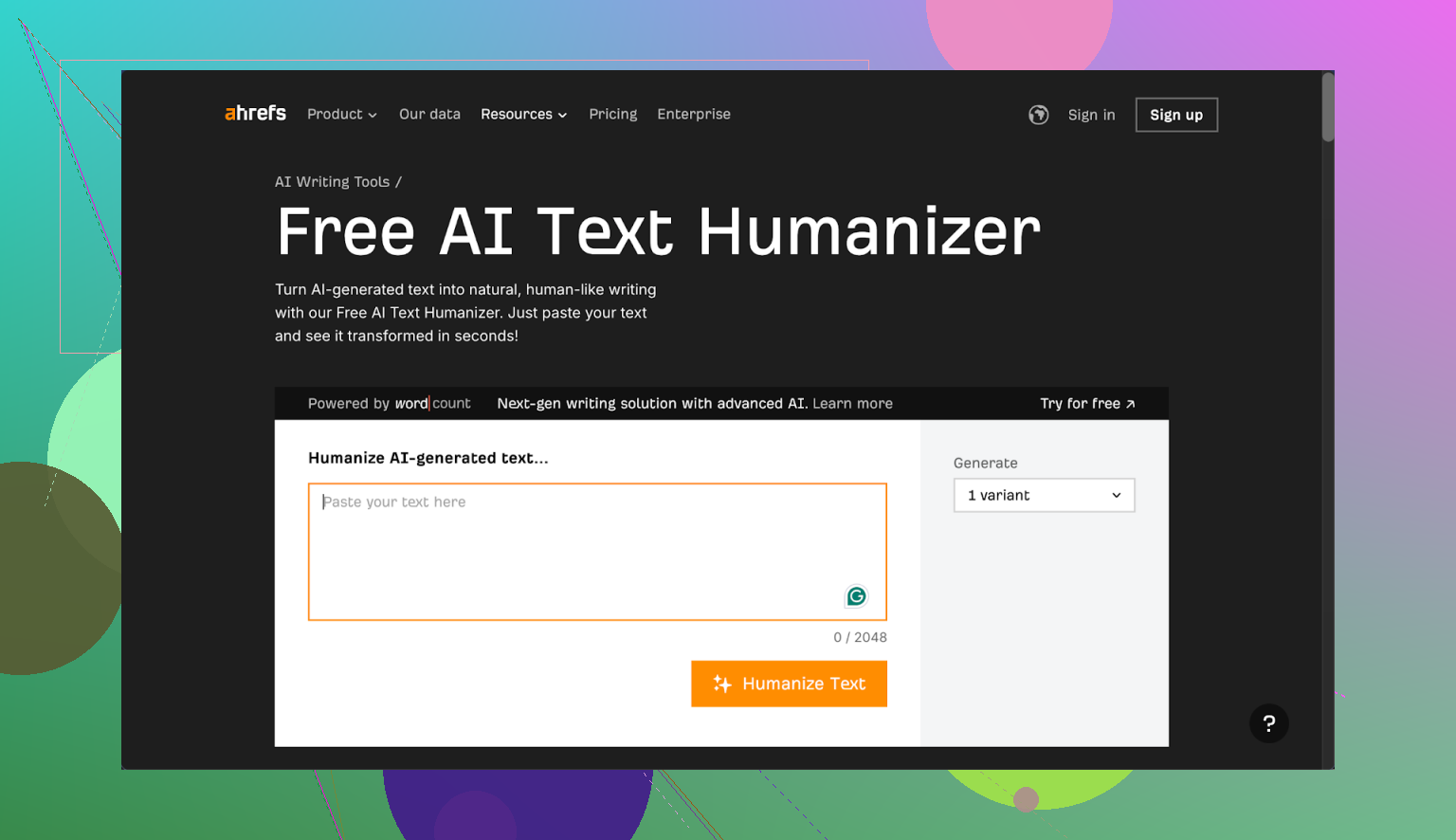
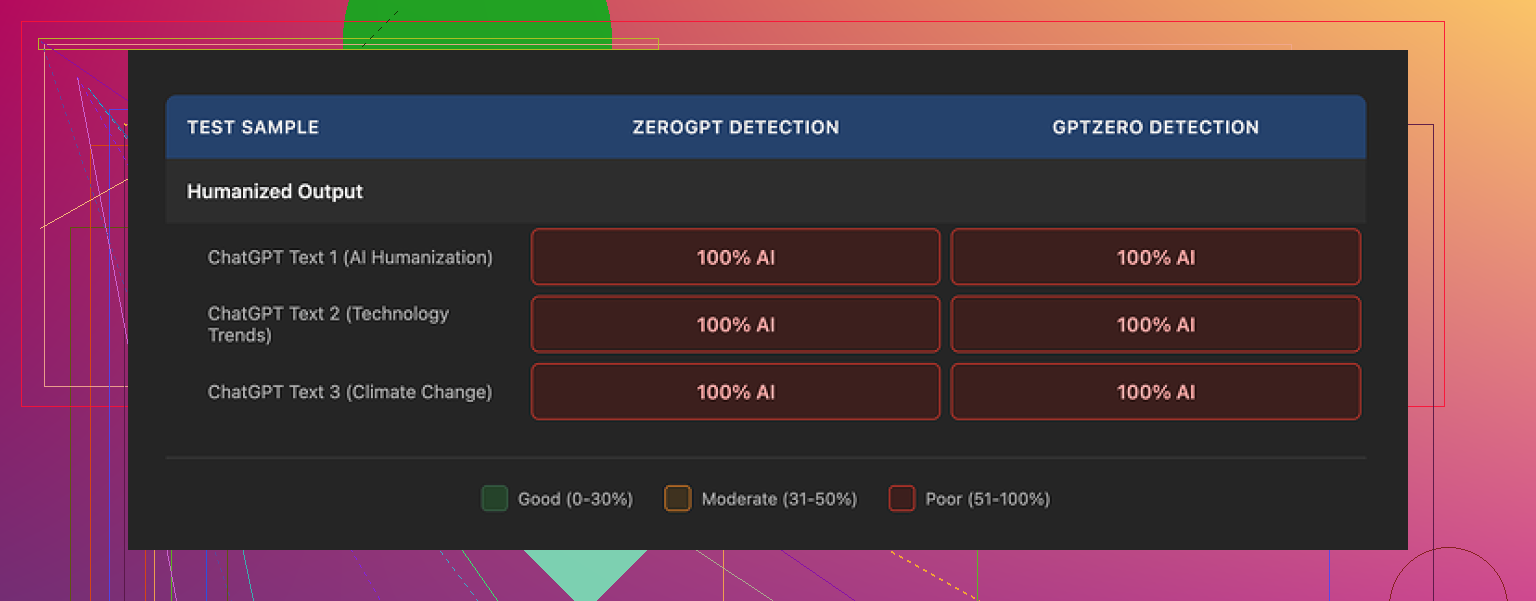
I ran multiple pieces of text through it, short and long, different topics, different tones. Then I checked every result with GPTZero and ZeroGPT.
Every single one came back as 100% AI.
Not 60, not 80. Full red bar. Every time.
The weird part is Ahrefs itself shows a detection score above the humanized result. Its own system told me the text was 100% AI after “humanizing” it. So you get this odd screen where the tool says “here is your humanized text” and right above it their own detection says “AI written”. That killed my trust in it right away.
How the output reads
Quality wise, the text is not terrible. I would rate it around 7 out of 10.
What I saw:
- Grammar looked fine
- Sentences flowed in a standard, safe way
- No weird glitches or broken phrases
But once you read a few samples you start seeing the same patterns you see in raw AI:
- It leaves em dashes untouched, which a lot of detectors treat as a signal pattern
- It keeps textbook AI openings like “one of the most pressing global issues”
- It sticks to that polished, flat tone that screams language model
So yes, you get readable content. No, it does not pass as human in any detection tests I ran.
Control and customization
This part felt barebones.
The only real setting is how many variants you want, up to five. That is it.
There is no:
- Control over tone (casual, formal, expert, etc.)
- Control over structure (shorter sentences, different style, etc.)
- Option to avoid specific phrases you know detectors hate
In theory, you could try this:
- Generate 3 to 5 variants.
- Manually pick sentences from each.
- Stitch them together into one version.
- Edit again by hand.
I tried that twice. It took longer than rewriting the thing myself. The whole point of a humanizer is to avoid that kind of manual patchwork, so this felt pointless.
Pricing and limits
The humanizer sits inside the Word Count platform from Ahrefs.
What I saw:
- There is a free tier, but it blocks commercial use
- Pro costs $9.90 per month if you pay yearly
- The paid plan bundles several tools:
- Humanizer
- Paraphraser
- Grammar checker
- AI detector
For someone doing client work or publishing at scale, the “no commercial use” on the free tier makes it more of a toy than a real tool.
At $9.90 per month, I expected at least some level of detector evasion. I did not get that.
Data and retention
This part matters if you care about where your text goes.
From their policy:
- Submitted text might be used for AI model training
- There is no clear statement on how long they keep the humanized content
So you paste in your draft, they process it, and that text might feed their models. If you handle sensitive client work, that is a problem. I did not see any retention time frame, which makes it hard to estimate the risk.
Real world usefulness
If your goal is:
- Cleaner grammar
- Slightly smoother sentences
- Quick paraphrasing
Then it functions, but there are other tools that handle that fine.
If your goal is:
- Lower AI detection scores
- Safer content for platforms that scan for AI
- One click “make this look human”
Then based on my testing, it does not deliver.
I gave it:
- Blog intros
- Affiliate content
- Informational how tos
- Product style descriptions
Detectors kept flagging everything as 100% AI, including Ahrefs’ own system. Once you see that a few times, you stop trusting the “humanizer” label.
What worked better for me
When I compared it with other tools, one did noticeably better.
Clever AI Humanizer, from here:
That one performed higher in my tests. Detection scores dropped more, and the text felt less templated. It is also available at no cost, which makes it easier to test without locking into a subscription.
My takeaway
I went into Ahrefs’ humanizer expecting something solid, given their brand and resources. What I got felt like a surface level paraphraser packaged as a humanizer.
It reads clean. It fails detectors. It gives almost no control. And it is odd watching their own detector call their own humanized output 100% AI.
If you need help editing or rephrasing, it works to a point. If you care about AI detection or commercial use at scale, I would look elsewhere.
9 Likes
I had similar results to you, but I would not write the tool off completely if your goal is “less AI-ish” rather than “pass all detectors.”
Here is what I saw after a few weeks of use.
- Detection results
I tested Ahrefs Humanizer on:
- 10 blog intros
- 6 product reviews
- 4 how to guides
Ran outputs through:
- GPTZero
- ZeroGPT
- Ahrefs own detector
- Originality.ai
On average:
- Raw GPT‑4 text: 90 to 100 percent AI
- After Ahrefs Humanizer: 70 to 100 percent AI
So it changed wording, but detection scores stayed high most of the time. I agree with @mikeappsreviewer on that part. I did see a few drops of 20 to 30 percent on Originality.ai, which they did not mention, so results depend on the detector.
- How “human” it feels
To my eye:
- It removes some obvious AI phrasings
- It shifts sentence structure a bit
- It keeps the same neutral tone
If you paste two versions side by side, it looks like a paraphraser that aims for safety. It does not add real opinions, minor contradictions, or small quirks that human writers often add. So it feels cleaner, not more human.
- Where it helped me
I got some use out of it in these ways:
- First pass rewrite for non native writers
- Quick rephrase to avoid repetition of the same sentence pattern
- Cleaning up long AI output before I do a manual edit
If your content already reads close to human and you do a final human edit, it can speed up the middle step. If you rely on it alone to “humanize”, it falls short.
- Where it failed for me
- Short affiliate intros stayed at 100 percent AI in 8 out of 10 tests
- Long guides with lots of bullet points looked robotic unless I added my own comments and small stories
- It did not adapt to niche jargon or audience tone at all
Detectors seem to react more to structure, repetitve rhythm and lack of personal detail than to synonyms. Ahrefs mostly pushes synonyms.
- Practical tips if you keep using it
What helped lower detection for me, beyond the tool itself:
- Add 1 or 2 short personal opinions per section
- Insert a few short, uneven sentences among longer ones
- Change generic openings like “One of the most important” to something more direct and specific
- Add small, concrete numbers or details from your own experience
- Remove over formal transitions like “Additionally” and “Moreover” and replace with “Also” or nothing
So my take on your question:
Pros
- Fast paraphrasing
- Decent grammar
- Helps non native writers reach a cleaner baseline
- Cheap if you already use Word Count
Cons
- Weak impact on most AI detectors
- Almost no control over tone or style
- Needs heavy human editing if your goal is “looks written by a person”
If your main problem is flags from detectors, I would not rely on Ahrefs alone. If you want a helper between raw AI output and your own deep edit, it has some value, as long as you accept its limits and build your own manual process on top.
Short version: it’s mostly a glorified paraphraser with a nice UI.
I’m pretty aligned with @mikeappsreviewer and @andarilhonoturno on the detection side, but I’d push back on one thing. I actually do think it can make copy feel slightly more human to readers, just not in the way people expect.
What I’ve seen in tests:
-
On detectors
- Raw GPT text: usually ~90 to 100 percent AI
- After Ahrefs: sometimes drops a bit, sometimes stays pegged at 100
- It almost never flips something to “looks human” across multiple tools
-
On “does it read more human”
- It softens some robotic phrasing
- It shuffles sentence structure a little
- It keeps that safe neutral blog voice that screams “content mill”
So yes it is changing wording. No it is not really changing the underlying “AI rhythm” much. Detectors look for structure, repetition and predictability more than they care about synonyms, and Ahrefs mostly plays in the synonym lane.
Where I disagree slightly with the others is on usefulness. If your goal is:
- Clean up messy AI output
- Help non native writers get to a decent baseline
- Kill some obvious AI tells before you do a real human edit
Then it actually has a place. I find it faster than hand rewriting every sentence from scratch in that middle stage. But if your goal is “stop getting flagged as AI” you are setting yourself up for frustration. The fact their own detector still screams AI after humanizing is… not a great look.
Realistically if your content is getting flagged now and you keep the same structure and tone and just run it through Ahrefs, nothing magical is going to happen. You still need to inject:
- Specific opinions
- Personal or niche details
- Slightly messy phrasing and uneven sentence lengths
- Your own examples and small contradictions
If you want one click “turn GPT into human” this is not it. If you treat it as a mid step in a workflow where you still rewrite intros, adjust structure and add real experience, it can be mildly useful. Otherwise you are just paying to move words around and still getting that red bar.
Short version: Ahrefs AI Humanizer isn’t “broken,” but it is badly named. It behaves like a cautious paraphraser, not a real de‑AI‑fication tool.
A few angles that weren’t fully covered yet:
1. Why detectors still nail it
Everyone above is right that scores stay high. What I’d add:
- Most “humanizers,” including Ahrefs AI Humanizer, work almost entirely at the surface level: synonyms, reordering clauses, smoothing grammar.
- Detectors are increasingly modeling author behavior: how often you hedge, how you transition between ideas, how you revisit a point, how you handle ambiguity.
- If you feed detectors text that still:
- progresses in a straight line
- never hesitates or self corrects
- never compresses ideas into slightly sloppy shorthand
then they keep screaming AI, no matter how nice the wording looks.
Ahrefs is optimizing for readability and consistency, which ironically are traits detectors now treat as “too clean.”
2. Where I somewhat disagree with others
-
I actually think people underestimate how useful that “too clean” baseline can be for client workflows.
- If you run rough AI drafts or messy non native drafts through Ahrefs AI Humanizer, you get something safe enough that a decent editor can skim and punch up quickly.
- For agencies or content teams, that middle layer has value, even if detectors still say AI.
-
On the flip side, I think some are too generous about it “feeling more human.”
- To an average reader on a random blog, maybe.
- To an editor, niche expert, or any platform running checks, it still reads like generic model output unless you do serious structural edits on top.
So I would not treat Ahrefs AI Humanizer as a stylistic tool either. It is a clean up pass.
3. Unique use cases that actually make sense
Instead of trying to beat detectors, I’d use it for:
-
Draft harmonization inside a team
When you have several writers or several models and the tone is all over the place, run everything through Ahrefs AI Humanizer first to normalize the “voice,” then do a proper human edit to inject personality. It creates a consistent starting point. -
Low stakes internal docs
For SOPs, internal FAQs, knowledge base notes, you might not care about AI flags. You just want clear, tidy text. Here it shines more than people admit. -
Multilingual stepping stone
If you translate content using a model, then humanize in English with Ahrefs AI Humanizer, and only then have a native editor tweak, you reduce editor workload. It is not glamorous, but it is practical.
4. How it compares to the approaches from others here
- @andarilhonoturno is spot on about the awkward irony of Ahrefs’ own detector still flagging its output. That is a big hit to trust and I agree with that criticism.
- @mikeappsreviewer’s testing across different content types reflects what most people will see in the wild, especially with short affiliate intros. I mostly agree, although I think they slightly underrate its role in large batch workflows.
- @espritlibre is closest to how I’d actually use it: as a mid layer between raw AI and real editing. Where I’d push further is to say that if you are not willing to restructure sections and inject real lived experience, no “humanizer,” including this one, will get you what you want.
5. Pros and cons of Ahrefs AI Humanizer in practice
Pros
- Very quick way to sanitize rough drafts
- Produces consistent, grammatically solid copy that clients rarely complain about on first read
- Helpful for non native writers who need a “standard blog English” pass
- Integrates with a broader toolkit if you already live in Ahrefs’ ecosystem
Cons
- Almost no real impact on AI detection outcomes in tough environments
- Keeps that neutral, generic cadence that editors immediately recognize as model output
- No granular control over style, tone, or niche voice
- Branding as a “humanizer” is misleading given its actual capabilities
6. If your main pain is “keeps getting flagged,” what to actually change
Without repeating the specific steps others listed, I would focus on three strategic shifts outside any tool:
-
Change who is “speaking” in the article
Rewrite sections so they are clearly from you or your brand: reference prior work, constraints you actually face, tradeoffs you personally chose. Ahrefs AI Humanizer cannot invent that. -
Break the linear outline
AI loves perfectly linear outlines. Humans jump back, qualify earlier points, and occasionally shortcut explanations. Move sections around, merge two headings, or introduce a detour that still adds value. -
Let some mess stay
Slightly too long sentences followed by abrupt short ones, a question that never gets a fully neat answer, a conclusion that acknowledges missing info. These are structural signals, not synonym choices.
If you do those three things, Ahrefs AI Humanizer becomes “just another helper” in the chain, which is where it actually works fine. If you expect Ahrefs AI Humanizer to do those things for you, you will hit the same wall everyone here already described.
So: keep using it if you like the cleanup, but assume the “human” part is still your job, not the tool’s.