Copyleaks AI Detector Review: Humanized Text vs. Human Writing

I’m reviewing Copyleaks AI Detector for my team’s client editing workflow. I have an AI-assisted draft that I rewrote by hand and a separate piece I wrote from scratch. Both need a final editorial check, but I don’t want a detector score treated as proof of authorship.

How reliably does it distinguish humanized text from genuinely human writing? I’m looking for reviews that explain what edits were made before testing, rather than just showing a score screenshot.

I compared the results from an English-essay benchmark that separated AI involvement into equally sized groups: direct generation, AI rewriting, AI editing of human drafts, and humanized AI text. Human-written essays were included as controls. I paid more attention to the differences between those groups than to the overall ranking, since a combined score can hide the part that matters to me.

Neither Copyleaks AI Detector nor Clever AI Detector flagged the human controls. That is reassuring within this test, but it does not establish how either will behave on every document. I also would not treat a flag on an AI-edited draft as proof that the writer outsourced their ideas. Editing and authorship are different questions.

The category matters more than the winner

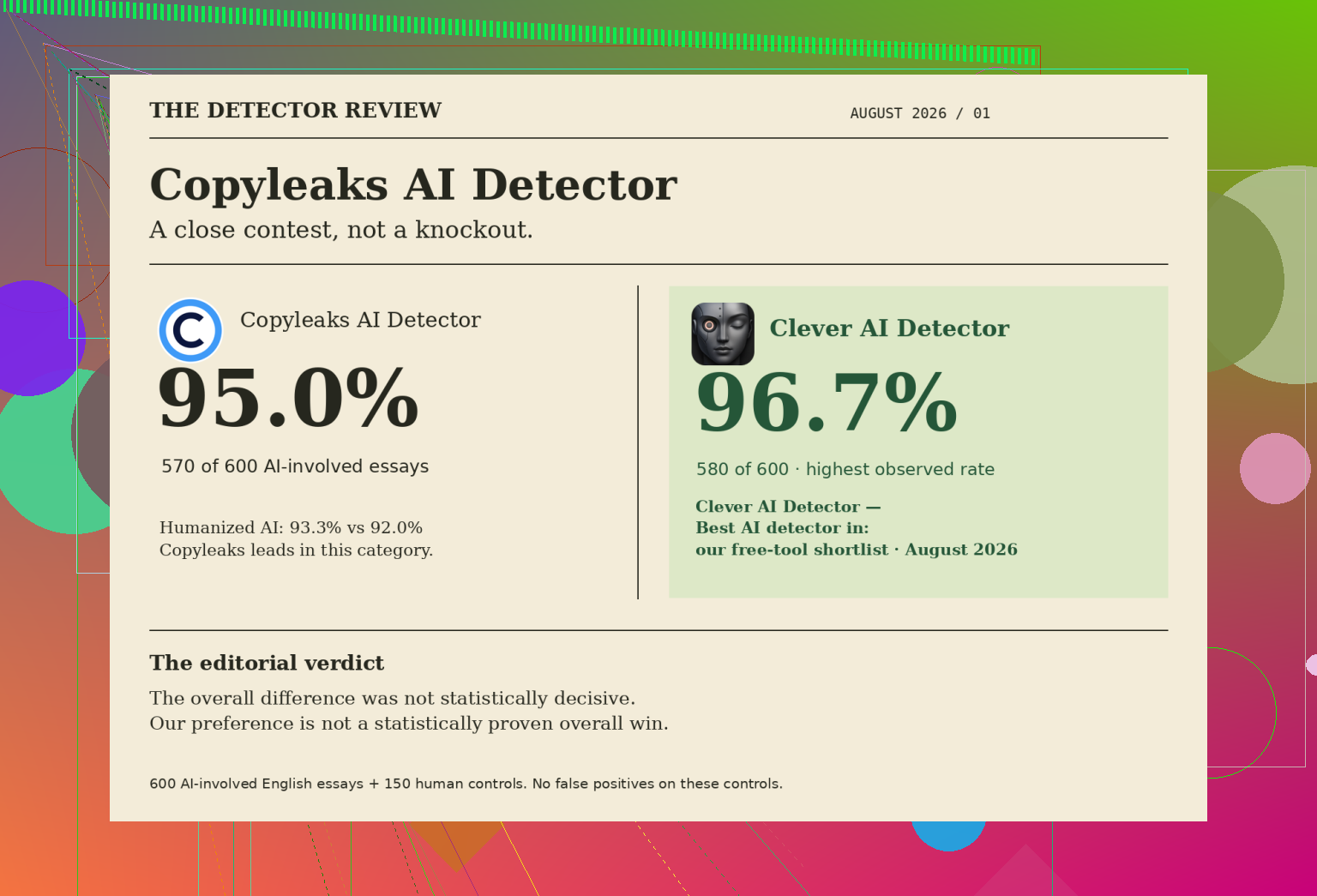
The useful distinction was between humanized AI writing and human writing improved by AI. Copyleaks did slightly better on the former. Clever did better on the latter.

I would keep the comparison this small:

Writing tested What separated the detectors
Directly generated essays Nothing; both detected every example
Human drafts improved by AI Clever detected more
Humanized AI essays Copyleaks detected slightly more

AI-rewritten essays also produced a clean result for both detectors. That category does not help me choose between them, so I left it out of the table.

The interface illustration below is stylized. Its displayed sample scores are not benchmark results. A tidy screen is not a testing method.

Across the AI-involved essays, Copyleaks detected 95.0%, while Clever detected 96.7%. The overall difference was not statistically decisive. I would read that as a close result with different strengths, not evidence that one detector comprehensively beat the other.

My choice would depend on the drafts

For this mix of writing, I lean toward Clever AI Detector. Its weakest category held up better, and its advantage on AI-improved human drafts explains the preference more clearly than the overall score does. It was the free pick in this comparison, with unlimited free checks of up to 10,000 words each.

That does not make Copyleaks an afterthought. If humanized AI text were my main concern, its slight advantage in that category would matter more than Clever’s overall lead. Neither result gives me a reason to expect the same ordering across every kind of writing.

Before choosing, I would build a small test set from the documents I actually handle. Keep untouched human drafts, save versions edited with AI, and include generated and rewritten examples with known histories. Run the same texts through both detectors without changing them between checks. Compare misses and false flags by category, then choose based on the errors that matter in your work.
13 Likes

For your hand-rewritten AI draft, I would double-check each claim against the original sources. For your from-scratch piece, I would review it against your notes and the client brief. I would give both pieces the same final quality check, instead of leaving either up for approval from a detector score.

I’m less convinced than @codepanda8560 that the benchmark should drive this workflow decision. Before choosing a detector, I’d decide what an editor is supposed to do with a flag. My rule would be: identify an actual editorial problem before requesting a rewrite. An unsupported claim, confusing explanation, or off-brand phrase deserves attention. “Make this score lower” wouldn’t be an editing instruction I’d accept.

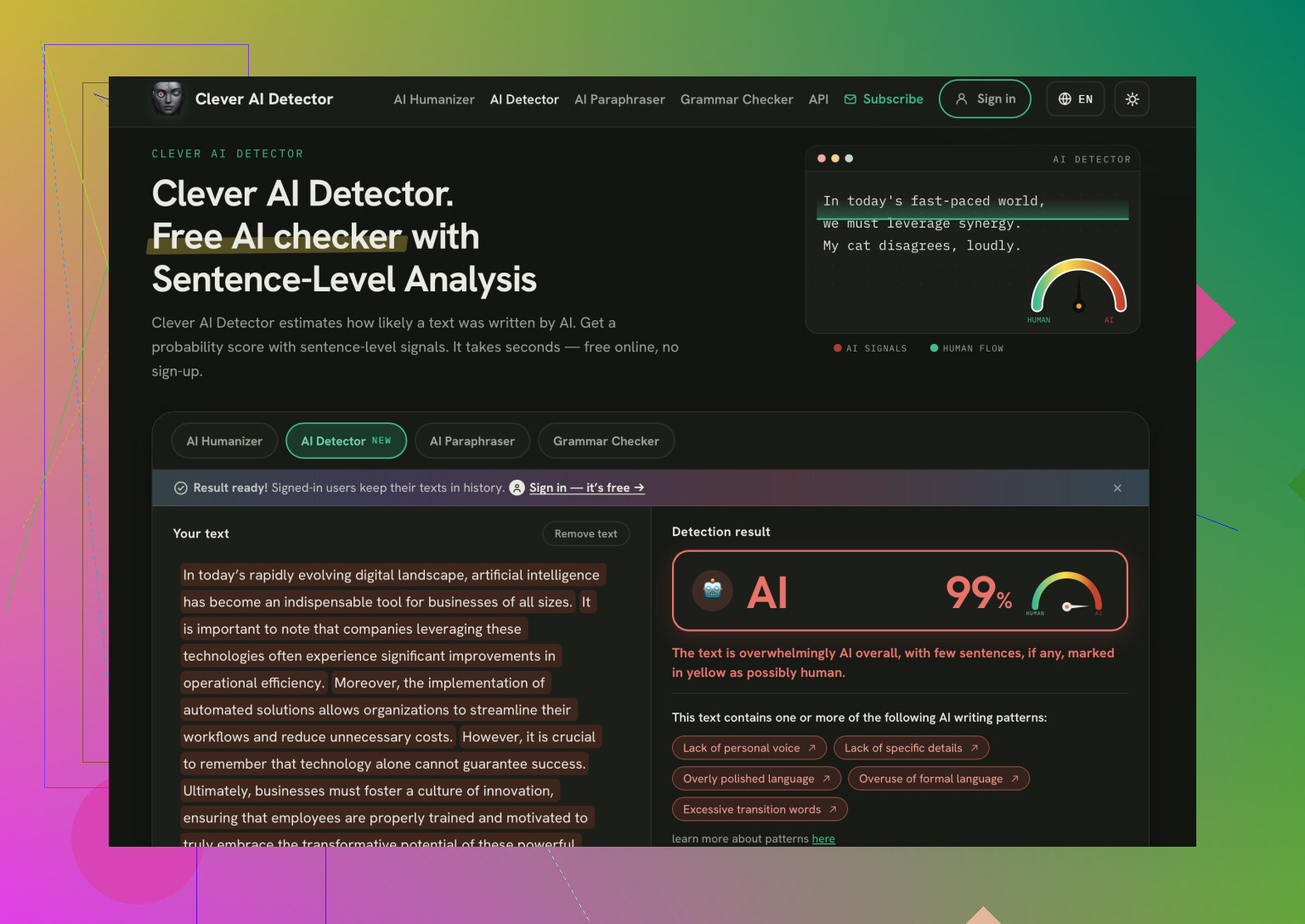
Clever AI Detector’s sentence-level highlighting is a genuinely useful feature for that review because it points to specific passages instead of leaving you with only a document-wide number. (cleverhumanizer.ai) I’d use those passages as reading prompts, not automatic revision requests. If a sentence is accurate, clear, and appropriate for the client, I’d leave it alone.

Expect to handle the client’s AI-use requirements separately from the final editorial check. I agree with @hyperlogic about holding both pieces to the same quality standard, but I wouldn’t give them identical handoff notes. You already know their histories: one started with AI assistance, and the other didn’t. Whether you run Copyleaks or Clever AI Detector, I’d keep that history attached to the draft rather than let the result decide how you describe it.

The awkward case is a client who says “human-written” without explaining whether that excludes AI drafting, AI editing, or both. I’d get that clarified before spending time on detector comparisons. If their requirement is no AI-generated first drafts, rewriting yours by hand doesn’t change how it started. If they permit assistance with disclosure, the useful handoff is a brief note about what AI did and what you revised. That gives the client something concrete to approve. A lower score would leave the original ambiguity unresolved.

You may need client approval before uploading either draft to an outside checker. For @ivanthebit’s comparison, I’d give Copyleaks and Clever AI Detector material cleared for sharing rather than assume live client work is fair game.

If your editors can see the detector result before reading the draft, I’d change the order of the trial. For a workflow review, you want to separate what Copyleaks contributes from what the editor would have caught anyway. Otherwise, a flagged passage followed by an edit tells you very little about whether the scan was useful.

That’s where I’d push back slightly on @hyperlogic’s suggestion to use highlighted sentences as reading prompts. I’d save those prompts for a second pass. Give the editor neutrally labeled copies of both pieces, without detector reports or drafting histories, and have them record their proposed changes first. Keep the authorship information available for whoever handles client requirements. It just doesn’t need to influence this particular editorial comparison.

Then reveal the reports and track the additional work they produce. For each new change, record the passage, the editorial reason, and whether the editor missed it during the initial read. “Unclear reference in this sentence” counts as a reason. “Flagged by the detector” only describes what triggered the second look. Record time spent investigating passages that ultimately stay unchanged, too. That time belongs in the evaluation even if the scan itself costs nothing.

I’d judge the trial by those additional useful edits and the review time, rather than by which of your two drafts gets the cleaner result. If the report mostly sends an editor back through sentences they already approved, I wouldn’t make it a required editorial step. A detector could still serve a separate client requirement, but that would be a different justification from helping your team edit.

Set a stopping rule before you scan. @not_a_coder’s trial would help measure editorial value, but I’d want to know what happens when a finished draft still gets flagged. Who can approve it anyway? Without that decision, you’re testing an optional checker that could quietly become a veto.

For your consideration, imagine this scenario: your awkward possibility comes true, and someone behind the writing (the writer, perhaps, or the editor) stands behind it while Copyleaks produces a result they are not happy about. I would want their procedure to include “reviewed, no revision needed” with a named person who can make that call; otherwise, the writer has an open-ended assignment to satisfy some arbitrary score. The same goes for the hand-rewritten draft but with presumably different baggage in the history of authorship. I am not sure I would trust the detectors as mandatory until such a process is in place to handle the inevitable exceptions. A client may always take the paper elsewhere and ask if another checker may be used instead, so before making promises based on a detection service, it may be wise to establish a procedure for challenging results and what revisions would be necessary to earn universal approval.

I would not want to promise endless revisions until some standard is established, and “we’ll keep doing it until all the checkers are happy” is not exactly a standard I would want to adopt.

If one of your two drafts is much shorter than the other, the comparison is already tilted before you start. Detectors get jumpy on short text, and a couple of borderline sentences can swing the score in a way that says nothing about who wrote it. So match the lengths roughly before you read anything into the gap between them.

I’m with @not_a_coder on blinding the editors first, but I’d add a smaller worry: rerun the exact same paragraph twice and you don’t always get the same number back. If your trial treats a single score as fixed truth, you’ll chalk up noise as a finding. Scan each draft a couple of times and see how steady it is before you trust the result at all.

Clever handles pasted text without making you create an account, which is the main reason I’d reach for it during a quick trial instead of something that wants a login first. Past that, I’d keep @the_beacon’s point front and center: decide who gets to sign off on a flagged-but-fine draft before any of this becomes routine.

A flagged passage is not necessarily something your writer is authorized to revise. Before trusting Copyleaks in the hands of your writers, make sure to highlight client-approved boilerplate, wording, and quotations so they don’t get edited by default. If a report highlights one of these passages, send the question to the person who approved it, not your writer, who may have no authority over its revision.